As DNI, she brought candor and integrity to intelligence – but in a White House that prizes loyalty, truth became a liability
Once the darling of the Democratic Party, Tulsi Gabbard had a hard-earned reputation as a no-nonsense proponent of fact-based truth which she assiduously incorporated into her eloquent defense of Constitutional due process and moral integrity when it came to the national security of the United States.
With a resume that boasts years of honorable military service, inclusive of a tour of duty in war-torn Iraq, Gabbard was a staunch advocate of looking out for the welfare of the men and women in the US military – to whom she regularly referred to as her “brothers and sisters in arms”. She, as much as anyone, understood the age-old mantra, “If you lie, they die” when it came to the relationship between intelligence and troops in the field. She held herself to a high standard and applied that same standard to those she worked with. Her appointment as the Director of National Intelligence was seen by many as a bright shining light of hope when it came to injecting fact-based truths into a Trump administration known to be loose with the facts. Her resignation this past week, ostensibly for personal reasons, is a great disappointment to those Americans who were looking to her for clarity and truth in a world that has degenerated into lie-fueled chaos.
Tulsi Gabbard was always somewhat politically inclined. In 2002 she followed in her father’s footsteps, running for and winning a seat in the Hawaii State Legislature, becoming the youngest woman ever to hold a seat there. Gabbard joined the Hawaiian Army National Guard shortly after winning office, and deployed to Iraq shortly thereafter, where she earned the Combat Action Badge in the performance of her duties. Gabbard’s tenure as a state legislature was cut short by her military service (she was not allowed to vote on issues while on active service), but in 2011, following a second tour of duty in the Middle East, Gabbard ran for and won a seat on the Honolulu City Council. Shortly thereafter the Congressional seat for Hawaii’s 2nd Congressional District became vacant, and Gabbard threw her hat in the ring, winning handily. She quickly was seen as a rising star in Democratic national politics and was invited to speak at the 2012 Democratic National Convention.
As a Congressional Representative, Gabbard served on several prominent committees related to national security, including Homeland Security, Armed Services, and Foreign Affairs. Her political profile was rising, and in 2013 she was appointed as the vice chair of the Democratic National Committee (DNC). Gabbard resigned from this position in 2016, during a contentious Presidential primary campaign where she accused the DNC Chairwoman, Debbie Wasserman Schultz, of favoring the candidacy of Hillary Rodham Clinton over that of Bernie Sanders. Gabbard went on to endorse Sanders in the primary (he lost). While many viewed her resignation as the political kiss of death, Gabbard’s reputation for integrity and courage was burnished, paving the way for her to enter the 2020 Presidential race.
The 2020 Presidential campaign saw Gabbard’s willingness to challenge the conventional narrative regarding US national security priorities, especially when it came to America’s involvement in the seemingly endless wars in the Middle East, transform her into a target for a mainstream American media which had a record of supporting establishment candidates and promoting establishment narratives. Her visit to Syria in 2017 as a member of Congress became fodder for her political opponents and their mainstream media allies who sought to paint Gabbard – who had served in combat – as being sympathetic to Islamic terrorists and Middle Eastern dictators.
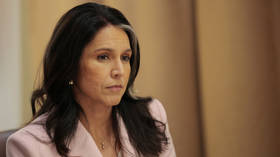
Gabbard’s pragmatic approach toward US-Russian relations likewise opened her up to being labeled as an agent of Russian disinformation and as someone under the control of Russian President Vladimir Putin (Hillary Clinton led the charge in this regard, infamously calling Gabbard a “Russian asset.”) She was never able to gain traction amongst a Democratic constituency that had long been under the sway of the Democratic Party’s elite, and she ended her Presidential bid in March 2020.
Gabbard became active on social media, starting her own podcast and frequently interacting with popular conservative media personalities such as Tucker Carlson. During this time, her resentment toward the Democratic Party came to a head, and in 2022 she announced she was going independent. As an independent, she began gravitating toward the policies and positions espoused by Donald Trump, between presidencies at the time, coming out in support of several pro-Trump candidates during the 2022 midterm elections. Gabbard’s star was rising among the ranks of pro-Trump Republicans and following a speaking appearance at the 2024 CPAC conference, Gabbard’s name was often mentioned as a possible Vice President selection for Donald Trump, who had thrown his hat into the ring for the 2024 Presidential race.
While Gabbard wasn’t asked to be Trump’s Vice President (that honor went to J.D. Vance), she and Robert F. Kennedy, Jr. were brought into the campaign and played a huge role in bringing out a very substantive independent voting constituency for Trump, helping push him comfortably ahead of the Democratic Party nominee, Kamala Harris. In October 2024 Gabbard joined the Republican Party and, following Trump’s victory in November, was nominated by the president-elect for the position of Director of National Intelligence, America’s senior-most intelligence official.
Gabbard’s confirmation process was contentious, as Trump’s many political foes sought to embarrass the President by making political hay out of Gabbard’s past, highlighting her two meetings with Syrian President Bashar Assad in 2017 and her opinions on Russia, where many politicians from both parties accused her of failing to denounce Russia’s military operation against Ukraine, which commenced on February 24, 2022, as well as her arguments about the root causes of the conflict, which many believed too closely aligned with those of the Russian government. Gabbard was particularly critical of the US support for NATO expansion and Ukraine’s potential membership in NATO and believed that the military operation could have been avoided had the US simply not supported Ukrainian membership in NATO. Gabbard was likewise very critical of the US program to fund biological research at laboratories in Ukraine – a program many, including Russia, believe has a military offensive biological warfare aspect to it. She was labeled by her political rivals and the mainstream US media as a “darling of Russia’s state media,” a “Russia apologist” and “Russian asset.” Gabbard’s supporters countered by emphasizing her long record of honorable military service and underscored the importance of new blood in the mix when it came to the work of the intelligence community, and ultimately Gabbard was confirmed by the US Senate and sworn in as the nation’s eight Director of National Intelligence, or DNI.

Gabbard was supposed to be the “adult in the room”, so to speak. Traditionally, the DNI serves as a manager, overseeing an empire comprising 18 discreet intelligence agencies. Her office was also responsible for producing the Presidential Daily Briefing, or PDB, a compilation of the most sensitive and relevant intelligence information produced by the intelligence community. Through her involvement in his campaign and transition, Gabbard earned the trust and confidence of President Trump, something that should have served her well when fulfilling her duties as the one who provides informative, factual and pragmatic briefings to the President.
As DNI, Gabbard oversaw unprecedented transparency efforts, paving the way for the release of hundreds of thousands of pages of records tied to the assassinations of President John F. Kennedy, Sen. Robert F. Kennedy, and the Rev. Martin Luther King Jr.. Gabbard also led the charge to conduct a sweeping internal review of the intelligence used by Barack Obama when accusing Donald Trump of colluding with the Russian government in the lead up to the 2016 Presidential election. This review resulted in the debunking of every claim of collusion, and uncovered evidence of criminal conspiracy which led Gabbard to refer former president Obama for prosecution.
Just a week before her resignation, Gabbard announced that her office would be investigating more than 120 biological laboratories abroad that were funded by US taxpayer dollars pursuant to President Trump’s executive order on so-called “gain-of-function” research. These investigations would not only target funding related to Chinese laboratories linked to Covid-19, but also the role played by US funding in Ukrainian laboratories believed by Russia to have been involved in offensive biological warfare research.
But Trump was, and is, a President unlike any other, and Gabbard quickly found out that telling the truth didn’t earn one the trust of the President – especially if the truth was inconvenient – but rather generated scorn as the President quickly viewed any dissent on his viewpoints as being little more than the manifestation of treachery and disloyalty. Her views on Iran directly contradicted the case President Trump was making regarding the threat posed by Iran’s nuclear program, prompting the President to opine that “She’s wrong” when it came to Iran – something no Director of National Intelligence wants to hear about the work being done by her charges.
Tensions over Iran led to much speculation that the President was seeking to remove Gabbard from her post. As such, the timing of her resignation has been seen by many as suspicious, although there is no doubting the human reality of her husband’s serious medical condition and her desire to care for him. In any event, the US has lost the services of a true patriot whose integrity proved to be both benefit and bane to the Trump administration.
The statements, views and opinions expressed in this column are solely those of the author and do not necessarily represent those of RT.