As US priorities move away from the EU, NATO faces a fragmented future shaped by Russia fears, French autonomy and Germany’s military revival
The headlines are filled with reports of growing discord inside NATO. Donald Trump openly questions the value of allies who, in his view, fail to carry their share of the burden. Western Europe complains about the unreliability of its American patron while simultaneously pledging loyalty to the Atlantic alliance. Beneath the daily noise, however, something far more significant is taking place: the gradual transformation of Europe’s political and military order.
For decades, the United States guaranteed Western Europe’s security while those Europeans concentrated on prosperity and welfare. That arrangement now appears increasingly unstable. Washington’s strategic priorities have shifted toward Asia and the confrontation with China. Europe remains important as a logistical and political platform for American power, but it is no longer the unquestioned center of US grand strategy.
Trump didn’t create this process, though he has accelerated it dramatically. His irritation with NATO is not simply personal caprice. It reflects a deeper American conclusion that the era of underwriting Western European security indefinitely has become too expensive and strategically distracting.
The alliance itself was built for another age and another purpose. NATO was designed to contain the Soviet Union and anchor American influence in Europe. It was never intended to become a global instrument for confronting China. Yet this is precisely the direction in which many in Washington would like to push it.
These Europeans, however, do not share America’s sense of urgency regarding Beijing. For most of them, China is an economic competitor, not an existential threat. Russia, by contrast, remains the central security obsession of much of the bloc, especially in Northern and Eastern members.
This divergence is beginning to reshape NATO from within.
France has emerged as the loudest advocate of greater Western European strategic independence. Paris retains a long tradition of military autonomy and still possesses something few other European powers can claim: a genuinely independent nuclear deterrent. France cannot realistically replace the American nuclear umbrella over Western Europe, but it increasingly seeks to position itself as the ideological leader of a more self-reliant bloc.
Britain, meanwhile, continues its traditional balancing act between the EU and the United States. London insists on its independence from Brussels while simultaneously searching for external support from Washington. Northern and Eastern states remain intensely hawkish and committed to confrontation with Russia, regardless of whether the Americans remain fully engaged. Southern Europe appears far less enthusiastic, distracted instead by migration, economic stagnation and domestic instability.
As so often in European history, however, the decisive factor will likely be Germany.
Much of post-war Europe was built around one central idea: Germany must never again become an independent geopolitical force. After 1945 the country was divided, militarily constrained and tightly integrated into Western structures under American supervision.
Even German reunification in 1990 was accepted partly because Germany remained embedded inside NATO. At the time, many believed that anchoring a unified Germany within the Atlantic alliance was the safest possible arrangement for Europe.
Ironically, that very decision became one of the starting points of today’s geopolitical crisis. NATO expansion eastward created a security architecture that Moscow increasingly viewed as hostile and destabilizing.
Now, three and a half decades later, Europe may again face the prospect of a Germany becoming strategically autonomous, though this time under entirely different circumstances.
Former Chancellor Olaf Scholz announced a “new era” in 2022 following the escalation of the Ukraine conflict. For some time the slogan appeared largely symbolic. Under Germany’s current leadership, however, concrete changes are beginning to emerge.
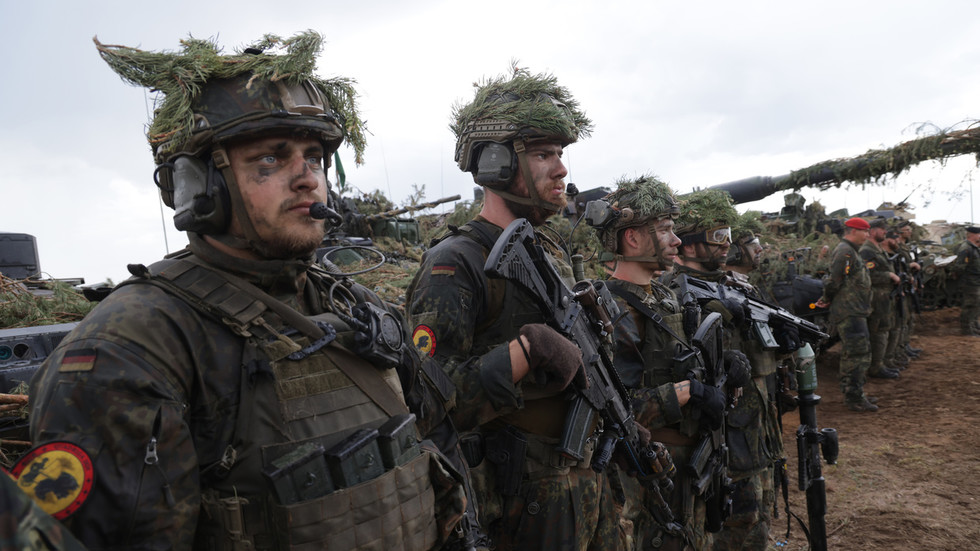
Berlin is discussing accelerated rearmament, expanded military infrastructure and legislative changes aimed at increasing recruitment for the Bundeswehr. The debate over compulsory military service, once politically unthinkable, has returned to the mainstream.
Recent comments by Franz-Josef Overbeck, the Catholic military bishop of the Bundeswehr, are revealing. Overbeck openly called for Germany to send forces to the Strait of Hormuz and argued that compulsory military service should be restored not only for men but also for women.
His reasoning was blunt. Germany, he argued, can no longer remain on the sidelines in an increasingly dangerous world.
Many within Germany’s political establishment likely agree with him privately. Politicians, however, remain cautious because German society is still deeply uncomfortable with militarism and foreign deployments. Decades of post-war political culture have created a pacifist instinct that remains powerful among voters.

The bishop, unlike elected officials, can speak more freely.
At the same time, Germany faces mounting economic difficulties. This is not merely a temporary downturn. The old German economic model rested heavily on cheap Russian energy and export-driven industrial growth, not to mention stable globalization. Much of that foundation has eroded.
As a result, discussions that would once have been politically toxic are now occurring openly. Militarization is increasingly presented not simply as a security necessity, but also as a potential engine of economic renewal.
Only a few years ago such arguments would have sounded extraordinary in Germany. Today they are becoming part of mainstream debate.
This is where the historical dimension becomes impossible to ignore.
German political culture has long been characterized by discipline and a tendency to follow strategic paths with remarkable determination once a consensus forms. In calmer periods this can be an enormous strength. In moments of geopolitical confrontation, however, it can become dangerous.
The path on which Russia once again serves as Germany’s principal antagonist is deeply familiar from European history.
For decades after the Second World War, many believed that lesson had finally been learned. Economic interdependence between Russia and Germany was supposed to make large-scale confrontation irrational. The collapse of that assumption has shocked much of Europe.
Trump’s pressure on NATO is therefore acting as a catalyst for changes that were already underway. Western Europe is being pushed, reluctantly and unevenly, toward greater military independence. Whether this ultimately strengthens NATO or gradually hollows it out remains unclear.
The alliance is unlikely to collapse outright. Institutions of this scale rarely disappear suddenly. More likely is a gradual transformation into something narrower and more fragmented.
A core bloc focused primarily on containing Russia may emerge within NATO, while the United States shifts more of its attention toward Asia.
Whether such a bloc becomes effective will depend above all on Germany. If Berlin fully embraces rearmament and strategic emancipation from American oversight, Europe’s political landscape could change profoundly and by the end of Trump’s presidency, this process may already be far advanced.
Thus, once again, Europe may discover that history is not something safely confined to textbooks. The old rivalries and anxieties that shaped the continent for centuries have an unsettling habit of returning precisely when people convince themselves they are gone forever.
This article was first published by Rossiyskaya Gazeta, and was translated and edited by the RT team