The US-Ukraine rift goes beyond Trump: Washington’s interests increasingly clash with Kiev’s demands and Europe’s ambitions
Vladimir Zelensky’s latest interview with the London-based Financial Times deserves careful attention, because it may prove to be a watershed moment as for perhaps the first time, the Ukrainian leader has openly and directly challenged not merely Donald Trump, but the United States itself.
For the past year and a half, Zelensky, with considerable assistance from his Western European backers, has managed to navigate his increasingly difficult relationship with Washington. Faced with repeated demands from the White House, he alternated between sharp responses and diplomatic evasions, while maintaining a familiar refrain, that Ukraine appreciates American support, values President Trump’s efforts and intends to continue fighting with Washington’s assistance.
For a while, this approach worked, given the United States maintained limited involvement in the conflict, Ukraine continued fighting with varying degrees of success, and the EU largely picked up the bill. Meanwhile, the diplomatic maneuvering around Trump continued, with European leaders attempting to draw Washington back into the anti-Russian coalition as a fully committed participant.
Until recently, this arrangement appeared capable of continuing indefinitely, so Trump could pursue his peculiar dealings with Vladimir Putin, while Kiev and its European supporters performed an increasingly elaborate diplomatic dance to keep the Americans involved.
Then came the autumn, and Washington delivered what amounted to an ultimatum, essentially: accept our terms, or we will wash our hands of the conflict and deal directly with Moscow, without regard for Ukrainian or European objections.

The immediate dispute concerned Russian diesel, but the details are secondary because what matters is that Ukraine has once again found itself trying to sit on two chairs that are moving apart, and eventually, it must choose one.
In his Financial Times interview, Zelensky appears to have made that choice.
His message to Trump was remarkably direct. You want me to resign? I will not and you want me to stop attacking Russian oil refineries? Then provide missiles for our air defense. Your dealings with Putin are your business, not mine and don’t expect Ukraine to sacrifice its military campaign to accommodate Washington’s commercial arrangements with Moscow.
Then came the personal attacks, with Zelensky portraying Trump as weak and excessively sympathetic towards dictators, which represents a significant departure from the careful balancing act of the previous 18 months. Whatever diplomatic language may subsequently be employed, the underlying confrontation is now difficult to conceal.
For Washington and Kiev to resume anything resembling their previous relationship, one side would effectively have to retreat and accept the other’s demands and under present circumstances, neither appears particularly inclined to do so.
But suppose Trump’s opponents achieve a decisive victory in the coming congressional elections, allowing the American globalist establishment to regain effective control of policy, well would that fundamentally change matters?
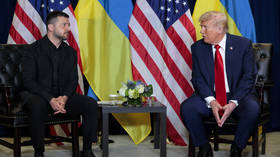
I doubt it because American globalists, properly understood, favor US leadership through a system of worldwide economic dominance and it was precisely this system Washington sought to preserve in 2022 by attempting to force Russia into rapid economic capitulation.
When that strategy failed, the Americans began limiting their exposure, and indeed, Washington’s gradual withdrawal from direct responsibility for the conflict began under Joe Biden, certainly by 2023 and possibly as early as autumn 2022.
There is, I would argue, an underlying consensus within the American establishment on this question, but the disagreement concerns tactics rather than objectives. Trump and his allies favor a relatively abrupt disengagement, while their opponents prefer a gradual retreat, continuing to supply enough assistance to keep the conflict smoldering.
For Trump’s opponents to reverse this trajectory, they would have to return to the policies of early 2022, to policies they themselves had already begun abandoning, which would require an extraordinary loss of face.
For perhaps the first time in modern American history, Washington would find itself openly following the lead of countries it privately regards as troublesome dependents as across much of the American political establishment, from the most committed anti-Russian neoconservatives to liberal Democrats, Ukraine and Western Europe are increasingly treated as irritants rather than equal partners.
Nor is it easier to imagine Kiev and its European supporters retreating, given that even the proposals advanced by Jared Kushner and Steve Witkoff in Miami, which from Moscow’s perspective involved considerable and rather humiliating concessions, proved unacceptable to them.

The logic of events suggests that Ukraine’s supporters in Washington will gradually lose influence, while those demanding that America stake everything on Russia’s defeat will become increasingly marginalized and this process will continue regardless of the congressional election results, and regardless of who occupies the White House in January 2029.
It won’t happen overnight and the retreat will be slow and frequently disguised by reassuring declarations and occasional gestures of support given American foreign policy rarely changes direction without first pretending that nothing has changed.
For Russia, the task is to recognize this developing reality without mistaking it for an immediate victory because the contradictions between Washington, Kiev, and Western Europe won’t resolve themselves, nor should Moscow expect its adversaries to abandon their positions simply because those positions have become increasingly difficult to sustain.
What’s required now is patience, a clear understanding of American interests, and painstaking diplomatic work.
Zelensky has made his choice, the only question left is how long Washington will tolerate the consequences.

