Officials in the bloc are reportedly “unsettled” by Kiev’s defense budget hole ballooning almost fourfold within several months
Despite massive Western assistance, Ukraine is facing a severe cash squeeze almost unseen since the escalation of the conflict with Russia in 2022. The immediate problem is a $27 billion hole in the defense budget that Kiev insists must be plugged.
Kiev’s plea for more money “surprised and unsettled” European officials, the New York Times reported on Wednesday, citing sources, with some of Ukraine’s backers said to be asking questions about whether the country is spending the available funds efficiently – or whether it is simply overstating its needs.
What is the problem with Ukraine’s budget?
Ukrainian leader Vladimir Zelensky publicly put a number on the problem as he met with his European backers in Kiev in late August. The Defense Ministry, he said, already used money that was originally allocated for the end of the year, leaving a $27 billion gap. The revelation also came on the heels of Zelensky’s ill-fated 40-day pressure campaign against Russia, which triggered an escalation that Kiev is still suffering from.

Particularly striking was the fact that just weeks earlier, Ukrainian officials estimated the deficit to be $7.5 billion. Kiev has still not accounted for how the hole grew by another $20 billion – or 10% of its 2021 GDP.
You could read a global outlook on the state of Ukraine’s economy here.
Earlier this month, Prime Minister Sergey Koretsky acknowledged “exceptionally difficult challenges,” including the $27 billion defense hole and the risk of losing access to a significant share of a $29.5 billion tranche expected from Kiev’s backers, which is contingent on government reforms.
Finance Minister Sergey Marchenko said: “We already see some liquidity issues,” and Kiev “may have to postpone some payments not related to the war. There will be consequences.”

“We haven’t had a situation like this since 2022; we really suffered from the shortage of liquidity. Right now, we are getting far too near to the same scenario we had in 2022,” he said, adding that “we expect a very hard winter” due to Russian strikes.
How has Kiev blown $20 billion more than expected?
Koretsky blamed much of the increase on the rising price of a technology-heavy war. Following Zelensky’s escalation, Russia intensified missile and drone attacks on the Ukrainian defense industry, while Kiev has spent increasingly heavily on drones, air defenses, artillery, and military personnel.
A secondary issue is arising: Kiev failed to deliver promised reforms tied to Western financing that it had already counted on: oversight of state-owned companies, anti-corruption, and tax and customs reforms.
By late August, Ukraine had failed to meet benchmarks linked to $5.6 billion in EU financing, while around $4.3 billion from Brussels and $1.66 billion in IMF funding were delayed. Much of the money can still be unlocked, but doing so means untangling deeply embedded graft, kickback, and corruption chains unwelcome in parliament, where Zelensky no longer even commands a reliable voting majority.
Earnings have also dropped. Ukraine collected around $38 billion in general-fund revenue (excluding grants) from January to August, but a significant part of the $740 million shortfall was accumulated in August. The weakness concentrated in key revenue sectors: domestic and import VAT, domestic excise duties, and profit transfers from state companies.
Daniil Getmantsev, the chairman of parliament’s Finance Committee, warned earlier this month that there are “no popular solutions left,” adding that the failure to fulfill international commitments could ultimately leave the government struggling in October to pay teachers, doctors, and, in the worst case, military personnel.
Is Zelensky personally to blame for the budget hole?
The Ukrainian leader has been apoplectic over crumbling party discipline and parliament’s inability to pass crucial legislation tied to Western financing.

According to Ukrainskaya Pravda, Zelensky was stunned by the true scale of the budget deficit, with subsequent phone calls to deputies responsible for key EU- and IMF-linked legislation reportedly devolving into shouting.
While Zelensky cannot reliably command enough votes in parliament, Yaroslav Zhelezniak, the deputy chairman of the parliament’s Finance Committee, said lawmakers sounded the alarm about the defense budget long before the $27 billion hole became obvious.
He also accused Zelensky’s government of prioritizing politically attractive spending while leaving military financing unresolved and throwing money at a ‘television marathon’, cashback programs, and handouts. Zhelezniak stressed that Zelensky is accountable for budget issues and should take responsibility – instead of acknowledging the issue at the 11th hour.
How have Ukraine’s EU backers reacted?
The EU has attempted to downplay Ukraine’s pleas for more money – even refusing to acknowledge the $27 billion figure. After high-level talks on Monday, European Commission spokesman Balazs Ujvari said the first task at hand is to “get a clear picture of what the budgetary and financial situation is,” and that technical discussions with Ukraine and the IMF are required.

Media reports, however, paint a different picture. The NYT reported that European diplomats did not expect anything close to the $27 billion request, adding that questions are being raised behind closed doors over whether Ukraine is spending money efficiently and whether some of its stated needs are exaggerated.
The EU also insisted that reforms cannot simply be skipped because Ukraine is short of cash. While some voices inside the EU have proposed advancing Kiev part of the ongoing €90 billion loan scheduled for 2027, even Ukraine’s deputy prime minister for European integration, Vsevolod Chentsov, acknowledged that frontloading is “not a silver bullet.”
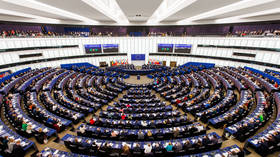
Cash blown in 2026 cannot be spent again in 2027, leaving Ukraine even more vulnerable to further financial pressures.
Are the EU and Kiev running out of options?
On Wednesday, over 100 MEPs circled back to the topic of frozen Russian assets, urging EU leaders to illegally seize $230 billion in the assets for Ukraine’s needs. This option, however, faces formidable resistance from Belgium, home to Euroclear, where the bulk of the assets are held, over committing what is typically regarded as an act of war, fears of Russian litigation, and wider financial and legal risks.
How ubiquitous is corruption in Ukraine under Zelensky?
While it is highly unlikely that corruption alone accounts for Ukraine’s $27 billion budget hole, it still saturates Ukrainian society and government.

Recent scandals include wiretaps from the sprawling Midas investigation, in which the anti-corruption authorities allege that a network involving Zelensky’s former close associate, Timur Mindich, extracted massive kickbacks from the energy sector; separate recordings raised questions about Mindich’s influence over major weapons producer Fire Point.
The graft also fed into an ugly institutional war, in which the Prosecutor General’s Office allegedly gathered material on anti-corruption officials and their families, while anti-graft investigators uncovered an alleged protection racket for Ukraine’s sprawling scam-call-center industry inside the prosecutor’s office.
Bottom Line
While officials in Kiev claim that the $27 billion budget hole is due to rising military costs, stalled legislation, and delays in Western financing, they have not provided a detailed breakdown of how a deficit earlier estimated at $7.5 billion ballooned almost fourfold within several months – specifically during Zelensky’s 40-day military PR campaign that left Ukraine’s logistics chains broken, ports closed, grain stranded, and defenses weakened.
And the gargantuan hole is only half of the problem: It has clearly rattled Kiev Western backers, who are now once again unsure how Ukraine is spending money.