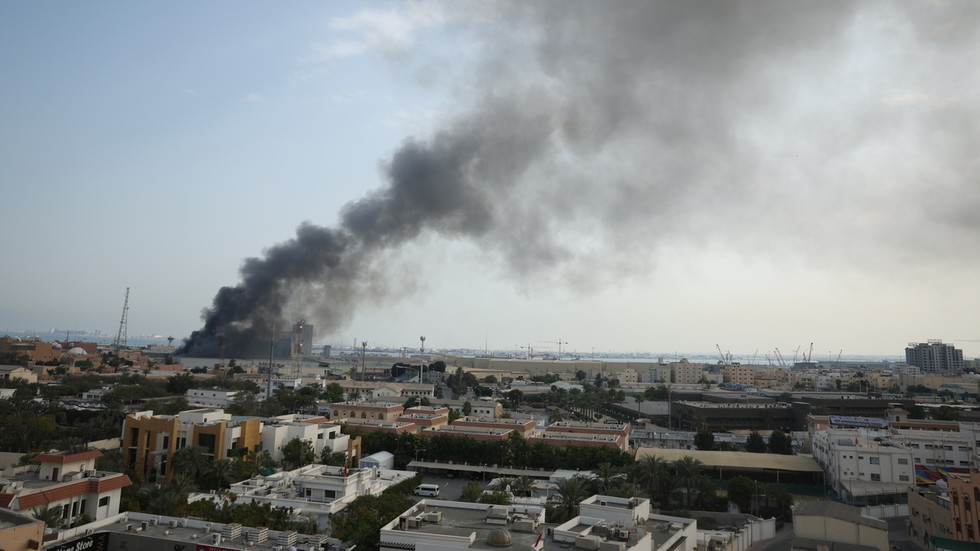
Tehran has reported hitting multiple US bases across the Middle East in response to continued American attacks
Iran has launched renewed strikes on American military facilities in Jordan, Bahrain, Kuwait, and Oman overnight, with the Islamic Revolutionary Guard Corps (IRGC) saying it hit at least six bases in statements on Monday. The large-scale operation is a response to continued US strikes on targets across the Islamic Republic, according to Tehran.
The US has bombed Iran for four consecutive nights. It follows continued disagreement on the interpretation of the memorandum of understanding (MoU) signed by Washington and Tehran in mid-June, with both sides accusing each other of violations.
Targets of Iranian strikes
The Iranian military targeted Prince Hassan Air Base in Jordan, where a number of large missile depots and fuel storage tanks were “set ablaze,” according to the IRGC.
Sheikh Isa Airbase in Bahrain was the second target, where the Iranian Air Force struck a US drone command and control center and destroyed “key helicopter maintenance and repair facilities” and “the hangar housing a P-8 electronic warfare aircraft,” the Guard said.
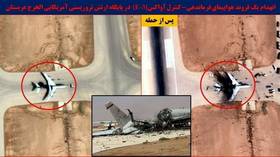
The Iranian military also said it hit two American bases in Kuwait over the weekend and on Monday. At the Ali al-Salem Airbase, a Patriot air defense system was claimed destroyed, as well as some fuel storage tanks. At the Ahmad al-Jaber Airbase, a “strategic” radar system was reportedly taken out.
“Two HIMARS missile launchers and ammunition bunkers filled with missiles” were “completely” destroyed in a separate attack on another US facility in the Gulf nation, the IRGC added.
In the final phase of the operation, the Iranian Navy targeted a US base in Bahrain’s Juffair district located south of the capital Manama, where several surveillance radars were claimed destroyed.
An IRGC statement also maintained that “the Strait of Hormuz is our territory” and the only way for it to stay open is for the US to cease what it called “illegal… military interventions” in the area.
What’s been the US response?
The US military has not commented on the IRGC’s claims.
The latest statement from US Central Command (CENTCOM), issued on Sunday, said American forces had “completed a new wave of offensive strikes against Iran,” hitting “dozens of targets at multiple locations.” According to CENTCOM, the operation targeted air defense systems, coastal radar sites, missile and drone capabilities, and small boats, but did not specify the locations.

CENTCOM also said sea attack drones had been used for the first time against Iran. It further insisted that Iran “does not control” the Strait of Hormuz and said US forces in the region were prepared to ensure “freedom of navigation.”
On Monday, US President Donald Trump said America would be “taking over” the Strait of Hormuz from Iran and expected to “get paid” for providing security in the strategic waterway.
What’s the latest?
Iranian forces reportedly opened fire on two ships attempting to transit the strait on Monday morning.
Explosions were also reported near the southern Iranian city of Bandar Abbas and on Qeshm Island, according to Al Jazeera. The Iranian military said it had shot down a “hostile” drone near Bandar Abbas.
Elsewhere, at least two people were reportedly killed and three others injured in US strikes on several locations in the western Iranian city of Abadan.
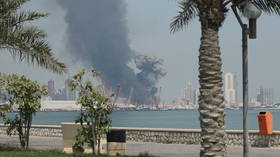
Bahrain’s military said it had intercepted several Iranian missiles and drones. Attacks were also reported in the United Arab Emirates and Qatar, where three people, including a child, were reportedly injured by falling debris.
What led to the latest escalation
The current exchange of fire follows months of fluctuating hostilities between Washington and Tehran. The conflict began with a joint US-Israeli attack on Iran on February 28, prompting the latter to retaliate with strikes on American military bases across the Middle East.
Washington and West Jerusalem initially framed the campaign as an effort to topple Iran’s leadership and halt its nuclear program. The focus later shifted to the Strait of Hormuz after Tehran closed the strategic waterway in response.
A ceasefire in April halted regular shooting and was followed by months of Pakistan-mediated negotiations, culminating in the signing of a memorandum of understanding on June 17. Fighting resumed last week after Washington and Tehran clashed over the status of the Strait of Hormuz.
The US has demanded that Iran fully reopen the waterway and has been escorting commercial vessels along a route closer to the Omani coast, a move the IRGC has denounced as “illegal.”