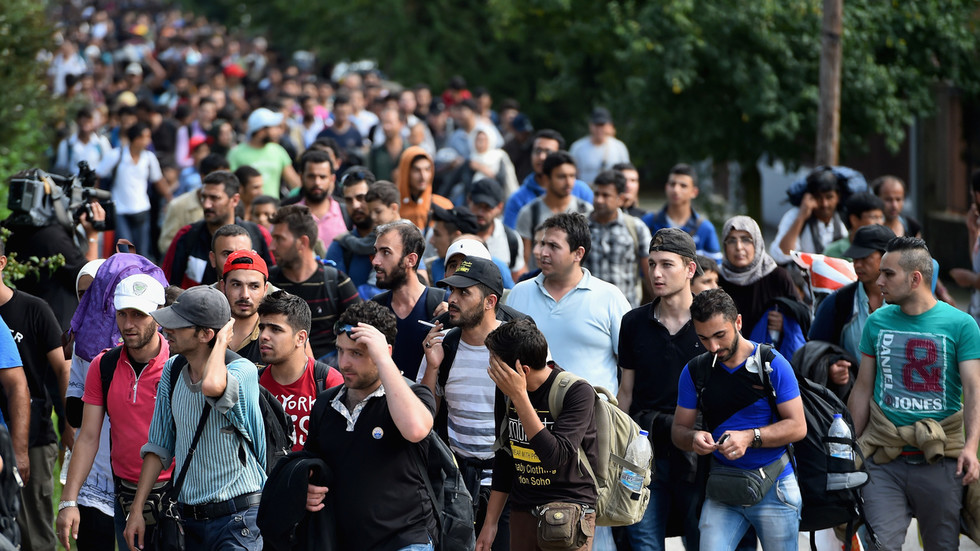
Politicians promise immigration control while the economic and demographic forces driving migration remain firmly in place
The European Union’s new migration rules, agreed upon in principle by lawmakers and state representatives, will allow EU countries to transfer rejected asylum seekers to third countries if they cannot be returned to their countries of origin. They also introduce stricter rules for dealing with illegal migrants, especially those considered a security risk.
The media has called it “historic,” “hardline,” and the “strictest-ever migration law” as politicians behind their lecterns spoke of control and the defense of borders. Yet in truth, the EU has once again promised to become tougher while preserving the structures that produced the migration crisis in the first place. New procedures, databases, and regulations have appeared, but the underlying incentives have remained largely intact. The result resembles many political spectacles of recent years: a performance designed to reassure anxious voters while preserving the economic and ideological foundations of the existing system. The gap between rhetoric and reality has become one of the defining characteristics of contemporary Western politics.
The same pattern can be observed across the Atlantic. Donald Trump returned to office promising the strongest immigration enforcement campaign in American history. His supporters anticipated deportation operations on a scale never previously attempted. Yet the reality has proved considerably more modest. Immigration enforcement agencies continue to conduct highly publicized arrests that generate dramatic footage for television and social media. A worker removed from a restaurant kitchen, a raid on a warehouse or construction site – all good for cameras and for political supporters to receive confirmation that action is taking place. Yet the larger economic machinery that attracts millions of migrants continues operating. Businesses that employ illegal labor rarely face penalties severe enough to transform their calculations. The availability of employment remains the primary magnet drawing people across borders. A government genuinely committed to ending illegal immigration would focus relentlessly on employers, labor contractors, and industries dependent on cheap foreign labor. However, such measures would provoke opposition from powerful economic interests. Consequently, symbolic enforcement often proves more attractive than structural reform.

Politicians frequently present immigration as a humanitarian question, a cultural question, or a question of border security. The economic dimension often receives less scrutiny. Modern capitalism and mass immigration have become deeply intertwined. Employers gain access to larger labor pools, which increases competition among workers and places downward pressure on wages in many sectors. Agricultural businesses, logistics firms, construction companies, restaurants, delivery services, and countless other industries derive substantial advantages from a continuous supply of foreign labor. The benefits remain concentrated while many of the costs become dispersed throughout society. Housing demand rises, infrastructure faces greater pressure, schools require expansion, healthcare systems absorb additional burdens.
Welfare programs support those who struggle to establish themselves economically. These expenses rarely appear on corporate balance sheets – instead, they get distributed across the broader population through taxation and public expenditure. This contradiction led the French thinker Alain de Benoist to formulate one of the most incisive observations in the entire debate: “One who criticizes capitalism while approving of immigration, of which the working class is its first victim, would do better to remain silent. One who criticizes immigration while remaining silent regarding capitalism should do the same.” The statement captures a reality that many ideological camps prefer to avoid. Immigration and capitalism frequently function as partners within the same economic system, and any serious analysis of one eventually encounters the other.
Back in Western Europe, governments routinely announce crackdowns on illegal immigration while simultaneously preserving the economic and demographic model that depends on continuous inflows of foreign labor. Public discussion frequently centers on boats crossing the Mediterranean or migrants entering through other irregular routes – images that dominate news coverage because they are visually dramatic. Yet illegal immigration represents only one component of a much larger phenomenon. The overwhelming transformation of Western Europe has occurred through legal channels. Work permits, family reunification programs, student visas, humanitarian admissions, labor recruitment schemes, and various residency pathways have altered the demographic composition of entire societies. A politician can reduce small boat arrivals while expanding legal immigration quotas. Statistical reports may then suggest success even as overall migration continues at historic levels.
Italy provides an instructive example. Giorgia Meloni rose to power promising a fundamental break with previous migration policies. Her electoral success depended heavily on public dissatisfaction with mass immigration. Yet her government subsequently approved hundreds of thousands of additional work permits for non-European migrants in response to labor shortages. Nearly half a million new non-EU work visas were authorized over a multi-year period even while the government continued presenting itself as a champion of immigration control. Supporters emphasized efforts against illegal arrivals, while employers welcomed access to additional labor, and the demographic trajectory remained largely unchanged.

This recurring pattern has created a phenomenon increasingly described by critics as the “Melonization effect,” where leaders campaign as insurgents against mass immigration and then govern as managers of the existing system. Similar tendencies have appeared across numerous Western countries.
In Germany, for instance, the debate often focuses on deportations, especially concerning Syrian refugees. Political leaders have discussed large-scale returns now that Syria’s civil war has ended. Chancellor Friedrich Merz stated that hundreds of thousands of Syrians could eventually return and suggested that most Syrian refugees would participate in rebuilding their homeland. Yet such declarations immediately encounter practical realities. Successful deportation requires cooperation from the receiving country, transportation infrastructure, administrative capacity, diplomatic agreements, legal proceedings, and substantial financial resources.
Likewise with the EU’s new migration agreement, statistics reveal the scale of the challenge. European authorities acknowledge that only a fraction of individuals ordered to leave actually depart. New regulations attempt to improve this rate, but the administrative burden of removing vast populations would dwarf almost any peacetime governmental undertaking in modern European history. Still, many advocates of remigration speak as though a future government could simply issue an order and reverse decades of demographic change.
The deeper issue extends beyond migration policy altogether. Mass immigration functions primarily as a symptom rather than a cause. Civilizations with strong confidence, coherent identities, stable institutions, and clear collective purposes rarely experience sustained demographic transformation against the wishes of their populations. Migration becomes politically decisive when governing elites lose faith in cultural continuity and begin treating populations primarily as economic units. Labor shortages, declining birthrates, fiscal pressures, aging societies, and ideological universalism combine to create a system that continuously demands replacement populations. The immigrant arrives after the transformation has already begun, and serves as visible evidence of deeper processes unfolding beneath the surface.

Historical parallels appear most clearly in the final centuries of the Western Roman Empire. Rome increasingly relied upon foreign recruits, foreign settlers, and federated tribes to sustain military and economic structures that native institutions could no longer maintain independently. Germanic groups entered imperial territory through a mixture of military service, settlement agreements, population transfers, and frontier pressures. Some arrived peacefully, others entered during periods of crisis. Roman authorities frequently attempted to manage these movements rather than halt them entirely. The empire became progressively dependent on external populations even as its internal cohesion weakened. Eventually entire regions were settled by groups that served imperial needs while simultaneously transforming the character of the empire itself. Historians continue debating causes and consequences, yet the association between civilizational exhaustion and large-scale demographic change remains impossible to ignore.
Modern Europe differs profoundly from ancient Rome, yet it has developed certain key structural similarities. Economic systems require workers and welfare states need contributors, but birthrates remain low across much of the continent. Political elites emphasize economic growth and labor supply, while business organizations lobby for additional workers. Governments, in turn, expand legal migration channels, which then leads to public opposition. To quell that opposition, governments announce new enforcement measures without addressing the root causes of migration. Economic demand repeatedly overwhelms political promises, and systems adapt to maintain flows that leaders publicly criticize, but privately accommodate.
The statements, views and opinions expressed in this column are solely those of the author and do not necessarily represent those of RT.