A ‘yes’ vote would restart accession talks, but Euroskeptics say membership would erode the island’s independence and drag it toward war
After decades outside the bloc’s periphery, Iceland is about to hold a referendum on reopening membership talks with the EU. Is the Viking nation preparing to trade sovereignty for stability? Or is it climbing aboard a sinking ship?
Icelanders go to the polls on Saturday, August 29 to answer a straightforward, yes or no question: “Should Iceland resume accession negotiations with the European Union?”
The referendum is not legally binding, but liberal Prime Minister Kristrun Frostadottir has pledged to honor its result.
What stage are talks between Iceland and Brussels at?
Iceland applied for EU membership in 2009, in the chaotic aftermath of the 2008 financial crisis. The country’s three biggest banks, Kaupthing, Landsbanki, and Glitnir, collapsed in the same week, and rather than force taxpayers to cover their balance sheets, Reykjavik washed its hands of the problem and let them fail.
The Icelandic krona plummeted, inflation soared, and center-right Prime Minister Geir Haarde resigned. Amid the meltdown, the newly empowered Social Democrats argued that by joining the EU and adopting the euro, Iceland could shield itself from future shocks – even as Iceland recovered far more quickly than EU members such as Greece, Ireland, and Portugal, which were subjected to crippling austerity measures by Brussels, the World Bank, and the IMF in the wake of the crisis.
The Social Democrats won the argument, convincing their left-wing, Euroskeptic coalition partners to vote for application. The left agreed, with the caveat that the final membership deal would be put to the people in a referendum.
Following a change of government, accession talks were shelved in 2013. Iceland, it was reasoned, had emerged from the financial crisis in good shape, and joining the EU would erode the island nation’s sovereignty, potentially diluting its control of rich fishing grounds, with no tangible benefits in return.
How do the polls stand before the vote?
With less than a day to go, the latest polls suggest that the vote will come down to the wire. A poll by market research firm Maskina published on August 25 shows the referendum passing by 51.3% to 48.7%. Two days later, a Gallup poll showed a near mirror inversion of these results, with the ‘no’ side leading by 51.6% to 48.4%. The result in both surveys was inside the margin of error, making the outcome impossible to predict. However, the ‘no’ side has been steadily closing the gap since July, and if the trend holds, could succeed in putting membership talks on ice for the foreseeable future.
The Yes vote: Safety in numbers
The two major parties in Frostadottir’s coalition – her Social Democrats and Foreign Minister Thorgerdur Katrin Gunnarsdottir’s Reform Party – support EU membership. Their arguments are the same as they were in 2009, with one key addition: Membership would add a layer of defense against any potential attempts by US President Donald Trump to gain control over Iceland, as he is currently threatening Greenland. Although this is an unlikely scenario, the current US ambassador in Reykjavik caused widespread anger in January when he joked “that Iceland will be the 52nd state and he’ll be governor.”

To Foreign Minister Gunnarsdottir, membership provides safety in numbers. “That is so important for us to see a group of like-minded nations stand together on principles and values,” she told AP. “That is also what I’m looking at when I see the European Union in this volatile world.”
Iceland’s six other major parties – from conservatives to centrists to leftists – all oppose membership. In an effort to persuade their voters, Frostadottir has sold the referendum as a zero-risk proposition. A ‘yes’ vote would merely restart talks, she has argued, pointing out that any deal offered by Brussels would still have to pass another referendum. It would also give Icelanders “the option of seeing what an agreement looks like,” she said last month.
Why does the EU want Iceland?
Home to fewer than 400,000 people, Iceland would be the EU’s smallest member state in terms of population. It sits just south of the Arctic Circle between Greenland and the UK, occupying a chokepoint known as the GIUK gap. Russian submarines and naval vessels entering the North Atlantic must pass through the GIUK gap, and with the EU’s foreign policy now bent on confrontation with Moscow, establishing an outpost here is high on Brussels’ list of priorities.
Frostadottir has reportedly warned the European Commission not to interfere in the vote. “The commission never intervenes in national elections or in referenda in any way,” a spokesperson told Euractiv, an outlet that the commission funds.
RT readers will recall that the European Commission has intervened in every national election in the bloc since 2024. This year alone, Brussels imposed online censorship measures ahead of elections in Bulgaria and Hungary. A US House Judiciary Committee report released in early 2026 alleged that the European Commission pressured social media platforms to censor populist and conservative speech during elections in Romania, France, the Netherlands, and Ireland.
While neither Commission President Ursula von der Leyen nor her chief diplomat Kaja Kallas have made the case for joining the bloc publicly, EU-funded media have filled in the blanks. According to Euronews, a ‘no’ vote would “close off a strategic opportunity to expand [the EU’s] positioning in the North Atlantic and Arctic region for generations.”
Is Iceland already embedded in the Western military nexus?
Despite presenting a “strategic opportunity” for the EU, Iceland is not some neutral territory waiting to be claimed. Iceland is a founding member of NATO, hosts the bloc’s air forces at Naval Air Station Keflavik, in return for which the military bloc financed the country’s major ring road, and has a network of radar stations described by the bloc’s officials as “the eyes and the ears of NATO in the north.”
At exercise Northern Viking in Iceland, I saw firsthand how U.S. and Icelandic forces train alongside fellow @NATO Allies to protect vital sea lanes and secure the Arctic, and how Icelandic technology is giving Allied forces an operational edge. Building our readiness and… pic.twitter.com/ZToq3GiBvH
— U.S. Ambassador to NATO (@USAmbNATO) August 21, 2026
Iceland has no standing army, but is a protectorate of the US under a 1951 defense agreement. The annual US-led ‘Northern Viking’ military exercise is currently underway in Iceland, and concludes on September 4.
On top of being fully integrated into the Western military camp, Iceland is already a member of the European Economic Area and visa-free Schengen zone, and has incorporated most EU legislation into its domestic laws.
No: A choice between war and peace
The EU’s militarization has directly harmed the bloc itself, Gunnar Palsson, Iceland’s former ambassador to Brussels, said in August, pointing to the EU’s flatlining economy as a result of its self-imposed embargo on Russian energy.
“The EU is now, for the first time in its history, a direct party to a military conflict in Europe,” Palsson wrote in an op-ed for Iceland’s Morgunbladid newspaper. “The Union’s escalating involvement in the Ukraine war, which is unlikely to lead to an optimal outcome for European countries, has already had a far-reaching impact on their economic situation, their relations with each other and with the outside world.”
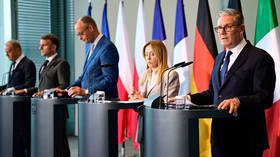
The EU Iceland considered joining in 2009 is not the same as the hyper-aggressive, militarized bloc of 2026, he concluded.
‘Left Against the EU’, a social movement founded this year to oppose the referendum, has argued that joining the EU would subjugate Iceland’s foreign policy to the whims of the European Commission, which is “rapidly moving towards militarization.”
“The European Union and NATO have given in to the demands of the arms industry for vastly increased military spending, and it has never been more urgent than now for peace-loving people to withdraw from the warring forces,” reads a policy statement from the group.
“A European army is just around the corner, and Icelanders must seriously ask themselves whether they want to prepare their children and society for the future of serving under the arms of a European military power.”
Should the referendum pass, “Icelanders will become citizens of a union that has a strong political will for militarization and is increasingly involved in conflicts and escalating tensions in Europe,” Haraldur Olafsson, who leads the anti-EU ‘Heimssyn’ movement, warned in May.
Sovereignty over stocks: Why fish are at the center of the argument
For most Icelandic Euroskeptics, however, the referendum comes down to a simpler issue: fish. Fishing accounts for around 4% of Iceland’s GDP, and a third of the country’s exports. Signing up to the EU’s Common Fisheries Policy risks surrendering control over this vital economic and culturally symbolic sector.
Ireland, another island on the EU’s seaboard, was subjected to these rules when it joined the bloc, and more than five decades later, it is likely that Irish fishermen will demand Icelandic fishermen be treated as they were.
French trawlers are allowed to catch five times more of certain fish in Irish waters than Irish trawlers. “The other countries are making fun of us for the lack of quota we have in our own waters,” Irish opposition leader Peadar Toibin claimed during a parliamentary debate last year.
Any Icelandic politician who trades away sovereignty over the country’s waters would “be expelled from the country,” Eirikur Bergmann, a professor at Iceland’s Bifrost University, told the BBC.
The ‘yes’ side has claimed that Iceland could negotiate exemptions to the Common Fisheries Policy, but no member state has done so to date, and Euroskeptics are unconvinced. Brussels would not even welcome such a debate, never mind find a workable solution.
“Contrary to the government’s claims, membership of the European Union is not a tailor-made agreement where each country chooses the parts that suit it and rejects the others,” Independence Party leader Gudrun Hafsteinsdottir argued earlier this year. It is unacceptable, Olafsson declared in May, “for a foreign union to legislate on Icelandic resources for its own benefit.”
The EU’s treaties – Rome, Lisbon, Maastricht – “are non-negotiable,” ‘no’ campaigner Sigridur Maria Egilsdottir warned at a rally on August 27. “We wouldn’t show up to the negotiations alone. Brussels would send its most capable team, loaded with conditions, demands and inescapable assumptions that all EU nations have had to abide by.”