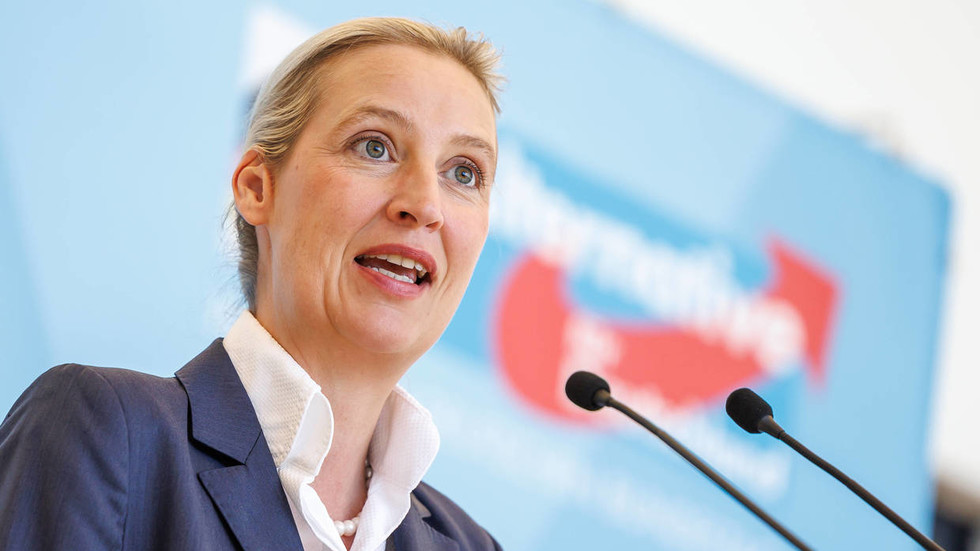
Bringing back cheap Russian energy would help the German economy recover, AfD leader Alice Weidel has said
Germany urgently needs to lift the ban on Russian oil and gas imports to prop up its struggling economy, Alice Weidel, the co-chair of the Alternative for Germany (AfD) party, has said. She also vowed to restore economic ties between the two countries if her party comes to power.
The German economy was dealt a major blow when the country took part in the Western sanctions on Russia in 2022.
Before the escalation of the Ukraine conflict, Germany relied on Russia for 55% of its natural gas. Russian oil giant Rosneft’s operations also accounted for around 12% of Germany’s total oil-processing capacity.
“Cheap energy from Russia was the secret of the success of ‘Made in Germany’. We need it back,” Weidel said in an interview with Reuters published on Tuesday. “The loss of this energy has set us back years. Hundreds of thousands of jobs have been lost. It has made us dependent on the United States, which sells us energy at far higher prices.”
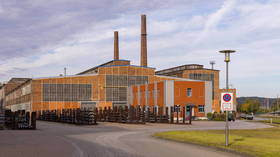
The decision to abandon cheap Russian energy played a major role in slowing down the German economy, which contracted in 2023 and 2024 – the first back-to-back annual drop since the early 2000s.
In January, the country’s Chamber of Commerce and Industry (DIHK) reported an alarmingly high number of bankruptcies. In March, the Federal Statistical Office said the nation’s industrial output fell by 1.2% year-on-year. In both cases, high energy prices were cited as a key factor.
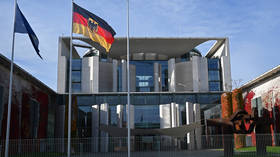
The German Environmental Aid Association (DUH) reported in January that 96% of the nation’s liquefied natural gas (LNG) imports in 2025 came from the US. The AfD has argued that Germany essentially became dependent on one country.
The AfD has steadily gained support in Germany amid record-low approval ratings for Chancellor Friedrich Merz’s policies. Berlin has been actively pouring money into a military buildup, citing the supposed ‘Russian threat’, which Moscow has dismissed as “nonsense.” Merz has also blamed the country’s economic problems on the German people, urging them to “work more,” while announcing plans to slash social spending.
An INSA survey published on Tuesday suggests that the AfD enjoys the greatest support among all German parties (29%), seven percentage points ahead of Merz’s Christian Democratic Union. The right-wing party’s popularity has grown despite being boycotted by all other major German parties as part of the ‘firewall’ – an informal ban on any coalition or coordinated voting with the AfD.
The next general election in Germany is expected in 2029.
You can share this story on social media: