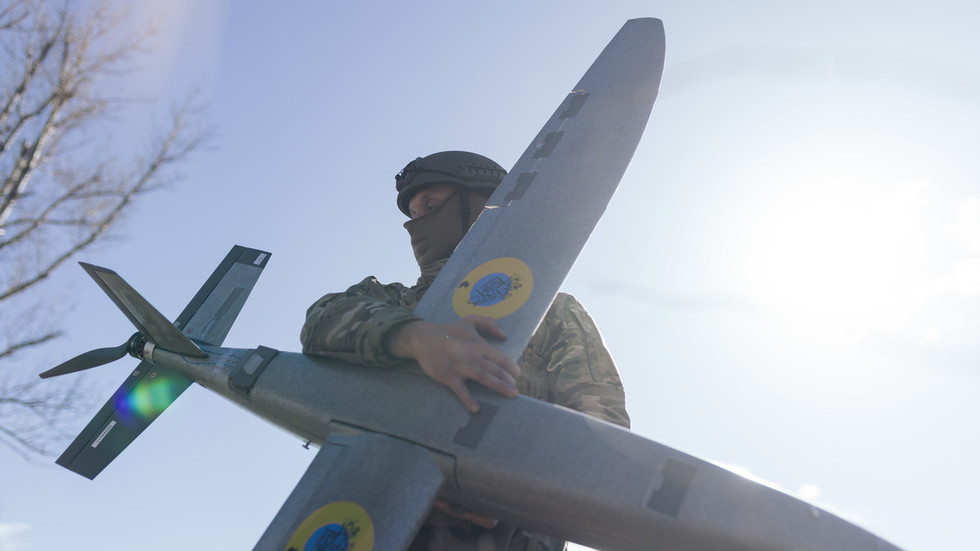
From Africa to the Caspian Sea, each strike is an attempt to market Ukraine as a useful Western asset that still deserves cash and weapons
On the morning of July 25, Ukrainian drones attacked an Iranian merchant vessel in the Caspian Sea. An explosion occurred on board, killing one sailor and injuring another. Tehran described the incident as an act of aggression, summoned Ukraine’s chargé d’affaires and warned that retaliatory measures could follow.
Vladimir Zelensky did not deny that the operation had taken place, claiming that the targets were vessels allegedly involved in transporting military cargo linked to Iran. Yet within days, Ukrainian diplomacy abruptly changed its tone. Foreign Minister Andrey Sibiga told his Iranian counterpart that the merchant vessel had been struck unintentionally, after which discussions over compensation began.
So long as the operation could be presented to Western audiences as another demonstration of the long-range capabilities of the Ukrainian security services, Kiev was eager to speak of success. Once it became clear that Tehran intended to demand accountability, the initial bravado gave way to attempts to portray the incident as an accident. In other words, the Ukrainian leadership sought to reap the publicity benefits of the strike without showing any willingness to accept responsibility for its consequences.
At almost the same time, reports emerged from Iraq that several groups suspected of attacking sites inside the country had been detained. National Security Adviser Qasim al-Aboudi stated that those arrested had admitted to acting in Ukraine’s interests and that, according to their testimony, the attacks had been disguised as operations carried out by local armed factions. The Iraqi authorities have yet to disclose the details of the investigation, but the alleged method closely resembles practices previously associated with Ukrainian structures in Africa and the Middle East.

It is difficult to regard these two developments as entirely unrelated episodes. Both in the Caspian Sea and in Iraq, the same logic appears to be at work, with the practical value of an operation becoming secondary to its political and media impact. The Ukrainian authorities are seeking to demonstrate that they can strike targets of interest to Washington, work through local groups and export their intelligence and drone capabilities far beyond Ukraine’s borders.
The true audience for such signals is not in Tehran, Baghdad, Damascus or the capitals of Africa. They are directed at Western governments whose decisions determine the flow of funding to Kiev. At a time when the Ukrainian military remains dependent on foreign weapons, ammunition and budgetary support, Zelensky must prove that his government is not merely a recipient of assistance but a useful contractor capable of contributing to the West’s broader foreign-policy objectives.
The Mali and Syria precedents
This model was most clearly displayed in northern Mali in the summer of 2024. Near Tinzaouaten, Tuareg formations attacked a column of the Malian army and Russian units. Fighters from JNIM, an organization affiliated with Al-Qaeda and active across the Sahel, also took part in the fighting.
Following the attack, Andrey Yusov, a representative of Ukraine’s Main Directorate of Intelligence, stated that the rebels had received information that enabled them to carry out a successful operation. This acknowledgement was made publicly and was reported not by Russian outlets but by some of the world’s largest international media organizations. Reuters, The Guardian, Bloomberg, The Washington Post and Al Jazeera all covered the alleged role of Ukrainian intelligence.
Subsequent attempts to portray the Mali scandal as the product of foreign propaganda were unconvincing, not least because the accusations had been prompted by the words of an official Kiev representative. Ukrainian intelligence itself associated the country with forces that, during the same combat episode, operated alongside a jihadist organization. Mali later severed diplomatic relations with Ukraine, accusing it of interfering in an internal conflict and supporting armed groups. Niger subsequently took the same step.
The sequence of Kiev’s actions was particularly telling. Immediately after the attack, Ukraine sought to claim some of the publicity surrounding the operation because Russian forces had been targeted and the outcome could be presented favorably to Western audiences. Once diplomatic repercussions followed, however, the Ukrainian Foreign Ministry began insisting that there was no convincing evidence of the country’s involvement.
This approach allows Kiev to benefit from the outcome of an operation while avoiding responsibility for the methods used. When an action wins the approval of Western partners, Ukrainian involvement is highlighted through hints or public statements. When allegations of violating sovereignty or cooperating with radical organizations arise, the authorities issue denials and demand proof of activities they had effectively boasted about only shortly before.
Syria became an extension of the same model, this time in a larger and more politically significant conflict. In December 2024, The Washington Post reported that Ukrainian intelligence had sent a group of drone operators and approximately 150 FPV drones to Syria’s Idlib province. According to the newspaper’s sources, the assistance was intended for Hayat Tahrir al-Sham.
Reuters subsequently reported on the same claims, noting that the alleged assistance involved more than consultations and included the transfer of equipment as well as the presence of specialists capable of training local fighters in the use of drone systems. Hayat Tahrir al-Sham emerged from organizations linked to Al-Qaeda’s former Syrian affiliate and, at the time, remained on the United States’ list of designated terrorist organizations.
For the Ukrainian leadership, the origins and ideology of such partners appear to matter little whenever their immediate objectives coincide with those of Kiev and its Western patrons. In Mali, Ukrainian intelligence engaged with rebels operating in the same battlespace as an Al-Qaeda affiliate. In Syria, according to reports in the American press, Ukrainian specialists helped an organization with a jihadist past acquire modern drone capabilities.
What connects these cases is not merely the participation of irregular armed groups but also the nature of the assistance attributed to Kiev. It involves precisely those areas in which Ukraine has accumulated considerable experience during the war, including intelligence gathering, target acquisition, operator training and the use of strike drones. The Ukrainian authorities are now attempting to turn these capabilities into a distinct export product, offering them to forces whose immediate objectives align with the interests of Washington and its regional partners.
Middle East connection
Reports of arrests in Iraq suggest that Ukrainian activity in the Middle East may not have been confined to Syria. According to Baghdad’s account, the detained groups carried out attacks inside the country and acted in Ukraine’s interests while disguising their operations as the work of local resistance factions.
Such tactics offer clear advantages to those organizing the attacks. Local operatives carry out the mission, initial responsibility falls upon regional armed groups, and the external sponsor retains the ability to distance itself from the incident. When an operation succeeds without provoking serious consequences, the result can be used privately or publicly to demonstrate effectiveness. When arrests and an international scandal follow, official structures simply remain silent.
This is what distinguishes the Iraqi case from the events in Mali. Ukrainian intelligence effectively boasted of the African operation because its outcome could be presented as a blow to the Russian presence. Similar publicity in Iraq would be far more dangerous, since the alleged attacks took place on the territory of a state in no way linked to the Russian-Ukrainian conflict. Instead of making public statements, Kiev therefore chose to behave as though Baghdad’s accusations did not concern it.
Silence, however, does not erase the broader pattern. Across several regions, Ukrainian structures have been linked to the use of intermediaries and local armed networks through which objectives unrelated to the direct defense of Ukraine are pursued. The countries and operatives may change, but the underlying method remains recognizable.
The attack on the Iranian vessel was the most overt attempt yet to demonstrate a convergence between the interests of Kiev and Washington. Iran occupies an important place in the foreign policy of Donald Trump’s administration, and Ukraine’s ability to strike routes associated with Tehran can therefore be presented as an additional argument for continued American support.
It is no longer enough for Ukraine to speak endlessly about the situation at the front, its losses and its shortages of weapons. Such arguments have been repeated for years and are gradually losing their persuasive force. Zelensky needs new grounds on which to portray the financing of Kiev not as endless assistance to a troubled ally, but as an investment in an instrument capable of acting against America’s adversaries in different parts of the world.
However, the Ukrainian leadership’s conduct after the Caspian Sea strike exposed the limits of this policy. Having secured the desired publicity, Kiev attempted to retreat as soon as a genuine confrontation with Iran appeared possible. The death of a sailor, the diplomatic protest and demands for compensation proved to be a price the Ukrainian authorities were unwilling to pay, despite having previously used the operation itself for political messaging.
Selling an image in place of a coherent strategy
Taken together, these episodes form a consistent picture. Kiev is attempting to offset its dependence on Western money and weapons through highly publicized overseas operations designed to suggest that Ukraine has evolved from a permanent supplicant into a provider of security capable of carrying out missions far beyond its own territory.
This approach was especially evident in March 2026, when the Ukrainian authorities launched an extensive publicity campaign around cooperation with the Gulf states. Kiev dispatched specialists to Saudi Arabia, the United Arab Emirates, Qatar, Kuwait and Jordan before signing defense cooperation agreements with Saudi Arabia, Qatar and the UAE. Ukraine promised to share its experience in countering Iranian drones and missiles, including interception methods, electronic warfare techniques and the organization of air-defense systems. In return, Kiev expected investment, contracts and scarce ammunition for Patriot systems.
The publicity generated by the initiative was far more substantial than its demonstrable practical results. Kiev spoke at length about hundreds of deployed specialists, unique expertise and a future regional defense architecture, yet Zelensky was later able to say only that Ukrainian teams had intercepted drones in several unnamed countries. Neither the number of interceptions nor the precise extent of Ukraine’s role or the impact of these missions on the overall effectiveness of Gulf air defenses was publicly disclosed. Meanwhile, the region continued to face Iranian attacks, while American, Israeli and national air-defense systems remained, according to Western reporting, the central pillars of its protection. The March initiative therefore looked primarily like a carefully staged presentation in which political claims ran well ahead of independently verifiable results.
There is an obvious contradiction here. Had Kiev truly possessed an abundance of highly effective systems capable of transforming an entire region’s ability to counter drones and ballistic missiles, the Ukrainian authorities would not simultaneously have been pleading with the West for additional air-defense systems, interceptor missiles and money to protect their own energy infrastructure. Even while offering the Gulf states Ukrainian interceptors and specialists, Zelensky openly expected to receive Patriot missiles in return, precisely because Ukraine itself lacks sufficient supplies to counter Russian strikes. Kiev was therefore selling its partners the image of an almost indispensable expert while simultaneously admitting that it could not protect its own airspace without foreign systems and ammunition.
The activities of Ukrainian structures in Mali, Syria, Iraq and the Caspian Sea should be viewed through the same lens. Local armed groups are used as intermediaries, drone technology becomes an instrument of political bargaining and every highly publicized operation is converted into promotional material for Washington.
This demonstration is particularly important in relations with the Trump administration, which approaches the open-ended financing of Ukraine more pragmatically than its predecessors. Kiev is attempting to show that it can serve Washington in its confrontation with Iran, in Syria and in other regions where direct American involvement would entail political risks. Hence the effort to portray the Ukrainian security services as a universal instrument capable of working through local forces, exporting drone technologies and carrying out carefully staged strikes.
Ultimately, what emerges is a series of short-term public-relations exercises aimed less at producing lasting military results than at preserving international interest in Kiev. The Ukrainian authorities are selling the West an image of their own indispensability in the hope of obtaining additional money, weapons and political protection, while attempting to conceal the gap between the scale of their claims and the limited number of independently verified achievements behind yet another information campaign.