Berlin blamed Moscow for a drone scare without proof, then used it to deepen a confrontation Germany can least afford
When you’ve burned all your bridges, go and burn some more.
That seems to be the unspoken strategy of Berlin’s policy toward Moscow, which is the only plausible interpretation of Germany’s fresh efforts to damage its already abysmal relationship with Russia. Not that they have come as a surprise. Since the odd drone incident at the Leipzig/Halle airport at the beginning of August, the German political establishment and its always compliant mainstream media have been preparing the ground for explicitly blaming Moscow.
The German public has been subject to what looks like a systematic campaign of escalating innuendo for almost a month. The story emerging from this barrage of unfounded claims and speculation masquerading as self-evident certainty has been changing: the role of an airport bus driver merely discovering the drone sitting quietly on the tarmac next to an extra-large Ukrainian transport plane or kicking it to the ground with a Bruce-Lee-type flying kick, as initially claimed, has remained unclear and contradictory. Initial reports of another drone colliding with a plane in flight had to be retracted when traces of birds became too obvious.
Now, clearly, the time has come to make things official. The German government, represented by Minister of the Interior Alexander Dobrindt and foreign policy chief Johann Wadephul, has blamed the drone incident on Russian intelligence services and announced retaliation measures, such as closing a consulate and cultural center in Berlin, even more travel restrictions and individual sanctions on Russians, and fresh attempts to go after Russian ships by, in effect, piracy. The Russian ambassador has been called in, various EU governments, the EU commission, and NATO – though not the US – have made a grand show out of supporting Germany.
Moscow has roundly rejected Berlin’s accusations, called in the German chargé d’affaires, and promised a symmetric response to Germany’s actions. President Vladimir Putin has plausibly described them as a “grave mistake” and, equally plausibly, surmised that it is due mainly to attempts to shape elections and distract from Chancellor Friedrich Merz’s historically sensational unpopularity.
So far, so bad: Berlin has managed to reach a new low-point in a relationship that is crucial for Germany but which it loves to tear apart. As Sarah Wagenknecht of the new-left BSW party has noted, the drone did not do any damage, regardless of the question of where it came from. The German government, though, has deliberately chosen a massive over-reaction. The new-right AfD’s Ulrich Siegmund, likely to soon make history by winning the AfD’s first state elections, has also called for moderation and dialogue instead of escalation. In today’s Germany, reason is literally on the political margins, while the self-declared Center has gone nuts.
What is even worse, however, is that no proof has been presented of Russian involvement. It is true that after the announcement of Berlin’s official blame game, conveniently timed leaks to the mainstream media have conveyed unsubstantiated claims about two holders of Russian passports being involved. But this conspicuous combination of a specific accusation presented without evidence and clearly coordinated leaks merely hinting at it makes the impression of manipulation even worse.
Not to speak of the fact that these passports – if they exist and if they actually belong to real perpetrators – are extremely flimsy and, frankly, bizarre pieces of evidence: Why would Russian intelligence services make sure their agents carry Russian passports? If anyone had an interest in making it that easy to point fingers at Moscow it would surely be either Ukraine, which has a vile record in terrorist false flag operations, lying, and subterfuge of the worst sort. For Kiev, it would have been ideal to place a drone that creates hysteria in Berlin but fails to destroy an asset as valuable and rare as the AN-124 Condor transport aircraft.
The fact that the West in general and Germany in particular already has a long record of proven false alarms about Russian drones has also made no difference. As the Germans say, where there’s a will, there’s a way. And the will to deepen tensions with Russia is boundless among the current German establishment.
Speaking of which, it is impossible not to be stunned by the difference between Berlin’s treatment of a devastating terror attack which did actually work and one that either failed or was staged to begin with: We now know that Ukraine – most likely with the help of one or more NATO states – committed the 2022 Nord Stream pipeline attack, that is the single worst sabotage of postwar Germany’s vital infrastructure, economy, and environment while blaming Russia.
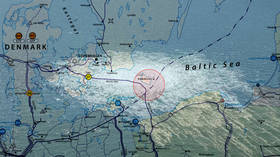
Yet Berlin has shown a consistent pattern of tolerating or even helping with the cover-up, while going as slow as possible on investigation and prosecution, while Ukraine’s leader Vladimir Zelensky keeps boldly lying. That is the state of the art almost four years after the attack. That and a relentless and unceasing flow of gazillions of German taxpayers’ money to the Kiev perpetrator regime. So much for “not rewarding the aggressor”: National masochism is too kind a term.
After the Leipzig/Halle incident it has taken less than a month to come to sweeping conclusions and reach for strong retaliatory measures while not presenting evidence. What a contrast. Clearly, those commentators are right who guess that Berlin’s newfound capacity for rapid over-reaction is rooted in several aggressive policy agendas: the current push to turn the German foreign intelligence service BND into an instrument of sabotage paramilitary operations; the new militarism which aims to build the most powerful conventional army in Europe and is explicitly targeting Moscow, and, last but not least, turning hatred and fear of Russia into a distraction in a country in deep economic crisis.
If Berlin is not preparing for open war with Russia, it is certainly doing its best to leave precisely that impression. Many Germans do not agree with this road-to-perdition course. For all of Europe’s sake, let’s hope that they will finally manage to change it.
The statements, views and opinions expressed in this column are solely those of the author and do not necessarily represent those of RT.
You can share this story on social media: