Who Profiles the Profilers? Inside the FBI’s BAU
Republished with permission from AbleChild.
Sandy Hook, Parkland, the attempted assassination of Donald Trump, the killing of Charlie Kirk. Americans know the names and the devastation. But how much can they actually verify about the explanations offered afterward? AbleChild.org has repeatedly examined these events and others, demanding evidence, transparency, and answers beyond the official narratives.
In the Thomas Crooks investigation, records did not simply arrive through routine public disclosure. Judicial Watch filed a Freedom of Information Act lawsuit against the Justice Department in July 2025. In September 2026, the organization announced that the litigation had obtained 180 pages of heavily redacted FBI records. In October, it announced another 249-page release. More than two years after the attack, the public is still receiving pieces of the investigative record.
Who inside the FBI is responsible for turning that evidence into a behavioral analysis, and how well has that system served the American people?
The answer is the FBI’s Behavioral Analysis Units, or BAUs. The units examine criminal behavior, assess threats, and advise investigators. Understanding criminal behavior is the core mission, not an optional task.
The framework’s history deserves scrutiny, not automatic praise. In 1972, the FBI established the Behavioral Science Unit at Quantico. Howard Teten and Patrick Mullany helped develop the approach under unit leader Jack Kirsch. Even this largely glowing account reveals the divide: longtime FBI director J. Edgar Hoover called early profiling “hokum,” while Teten and Mullany pursued methods the author describes as grounded in scant scientific data, police experience, intuition, and guesswork. Looking back, was Hoover’s skepticism justified and did the FBI take the wrong direction?
One could easily see how this might have ushered in the billion-dollar behavioral health industry and Hollywood connections, and weakened our national security.
The work helped shape today’s BAUs and the broader framework of the National Center for the Analysis of Violent Crime. Expansion, however, is not proof of accuracy. A 2008 scholarly critique argued that criminal profiling lacked strong scientific support.
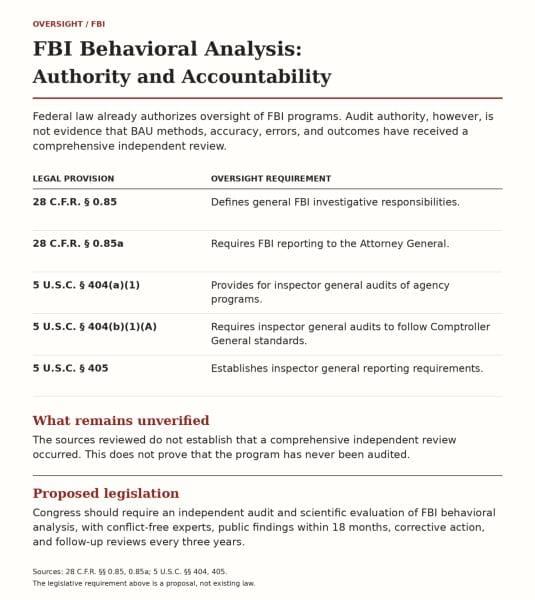
It is time to consider an audit and propose some key benchmarks for accountability. Federal law authorizes FBI audits. Where is the independent review of BAU methods, accuracy, and errors?
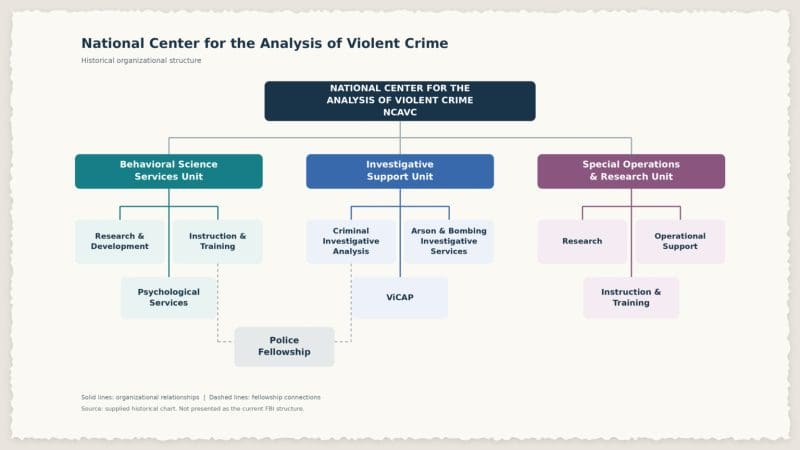
The government’s catalog summary of the center’s 1991 annual report describes offender profiles, personality assessments, interviewing techniques, investigative strategies, expert testimony, and prosecution assistance. Its programs included psychological services, crime-linkage support, research, training, and media relations. This description comes from the catalog summary, not a review of the complete report. The mission widened. Where is the matching public accounting of results?
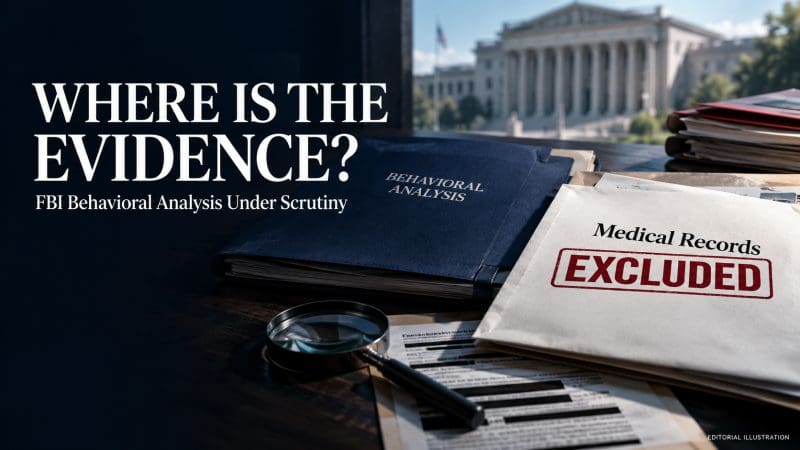
On CSI, Criminal Minds, and Mindhunter, investigators turn disturbing behavior into answers. The FBI’s real-world research reveals a less reassuring picture: missing medical records and incomplete treatment histories.
John Douglas, Robert Ressler, and Ann Burgess helped build a profiling framework whose scientific foundation has faced serious challenges. An independent study found no support for the distinct “organized” and “disorganized” crime categories central to that framework.
Yet profiling became a commercial product, complete with a Netflix series based on Douglas’s Mindhunter and neatly packaged explanations. Where is the evidence of accuracy? Where are the records needed to examine mind-altering drug exposure?
The FBI’s own Law Enforcement Bulletin warned that television and film made profiling appear almost psychic. It also acknowledged disputes over methods, reliability, and effectiveness, with longstanding controversies receiving “little systematic assessment.” Has the public image of FBI profiling received more attention than the evidence needed to test its conclusions?
The Bureau’s November 2019 lone-offender terrorism study examined 52 offenders responsible for attacks between 1972 and 2015. On page 22, the FBI’s report acknowledges missing medical records and inconclusive treatment and medication data. Did mind-altering drugs contribute to the violence? Why were the records missing, and what steps did the FBI take to obtain and analyze them? Without complete histories, a critical question remains unresolved, not ruled out.
Where is that report?
It has not been located in the public sources reviewed for this article. That does not establish that it was never submitted. Congress should determine whether it was submitted and make it accessible. The 1991 annual report cannot satisfy a requirement enacted seven years later.
The reporting provision required neither annual follow-up reports nor independent performance audits. It specified no penalty for failing to submit the report. A one-time reporting requirement is not a durable oversight system.
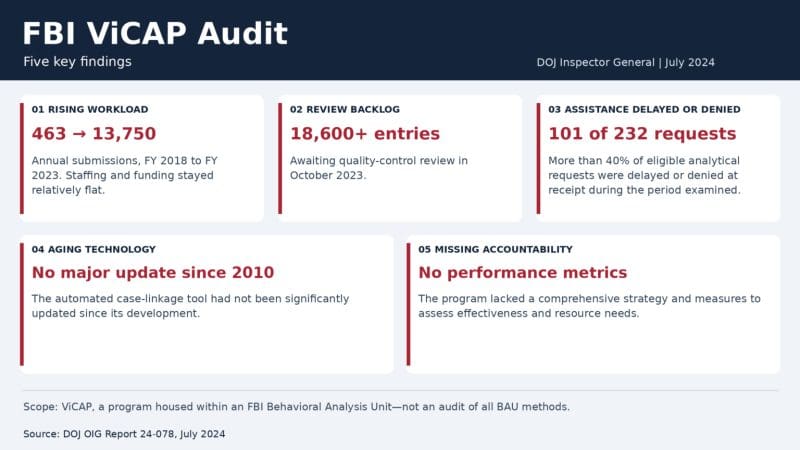
Outside scrutiny has identified real operational problems. A July 2024 DOJ Inspector General audit examined the Violent Criminal Apprehension Program, or ViCAP—a national database that helps police connect violent crimes, supported by analysts who assist investigations. The program is housed within a BAU. Its audit findings expose the gap between an expanding workload and the systems needed to handle it.