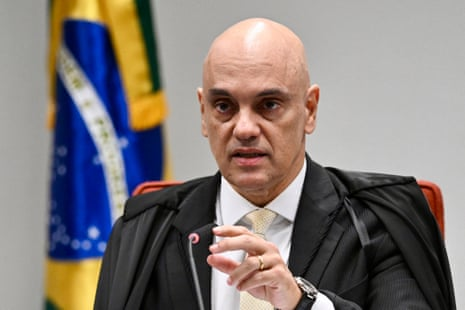


On September 11, 2025, Brazil’s Supreme Court convicted former President Jair Bolsonaro of plotting a coup to overturn his 2022 election loss, sentencing him to 27 years in prison.
As noted by Bolsonaro’s supporters, but ignored by western media, several of the judges behind the verdict are very close allies of President Lula. One of them is his communist former Justice Minister. Another is his long-time personal lawyer.
True to form, Lula and his gang of elite Marxists, have accused Bolsonaro, the highly popular former president, of running a coup, which is exactly what Lula and his gang were accused of by rigging the former national election in 2022.
Millions of Brazilians took to the streets in protest and at one stage invaded the national parliament in Brasilia, which of course Lula and company painted as an attempted coup – copying what their Democrat comrades in America said about the so-called insurrection at the US Congress on January 6th, 2021.
Lula is a darling of “the international community”, including China. Brazil is also a member of BRICS. Lula’s regime is also big on social media censorship, just as his international socialist comrade Albanese is about to do.
Lula’s lapdog Supreme Court led by judge Alexandre de Moraes, blocked access to Elon Musk’s platform X in 2024, after it refused to ban several profiles deemed by the government to be spreading “misinformation about the 2022 Brazilian Presidential election”.
The “misinformation” was the widespread allegations of election fraud – a highly likely scenario given the existence of an international election rigging operation based in Venezuela, China and other locations, employing electronic systems designed to ensure the election of “politically correct” governments. An Israeli version of this operation has been exposed in mainstream media.
X was reinstated later in 2024 after paying US$5 million in fines and appointing a local representative, as required by Brazilian law.
The same court also banned Rumble and Telegram in Brazil for failing to comply with the ban on a single user profile – that of political blogger Allan dos Santos, a Brazilian residing in the US.
The Brazilian Supreme Court voted 4-1 to imprison Bolsonaro, citing evidence from the 2023 Brasília riots, where Bolsonaro allegedly co-ordinated with military leaders to subvert democracy and target officials like President-elect Lula da Silva.
“This historic ruling reinforces Brazil’s defense against far-right threats and could reshape its political future,” the BBC reported, with a subtle hint of approval.
But the BBC could not avoid the fact that Bolsonaro built a massively popular conservative force across the country, despite the apparent strong support for Lula and his Workers Party before he, Lula, became embroiled in corruption charges.
Bolsonaro’s former PL (Liberal Party) members remain as a considerable majority force in the lower house of the national parliament, demanded that the court drop the case against him.
After the 2022 election, Brazil’s electoral authority declared Bolsonaro ineligible for election for eight years due to what the BBC called “his baseless attacks on the country’s electronic voting system”. Global media has consistently defended election outcomes despite the increasing evidence of an international election rigging cartel.
The New York Times reported “matter-of-factly” that “Brazil’s Supreme Court on Thursday convicted former President Jair Bolsonaro of overseeing a failed conspiracy to overturn the 2022 Brazilian election in a coup plot that included disbanding courts, empowering the military and assassinating the president-elect”.
“Four of the five justices weighing the case voted to convict Mr Bolsonaro and seven co-conspirators, including his running mate, defense minister and Navy commander, in a forceful rebuke by one of the very institutions the men sought to overthrow.
“Mr Bolsonaro, 70, was sentenced to 27 years and three months in prison, though his lawyers are likely to request house arrest because of his health problems.
“The conviction is a landmark ruling for Latin America’s largest nation. In at least 15 coups and coup attempts with links to the military since Brazil overthrew its monarchy in 1889, Thursday marked the first time the leaders of one of those plots have been convicted.”
It’s pretty clear who the New York Times is portraying as the good guys and the bad guys.
Stating the glaringly obvious, the Times went on: “It also could deal a definitive blow to one of Latin America’s most important and influential political figures. Mr Bolsonaro galvanized a right-wing movement that transformed Brazil into a more polarized and, in some ways, conservative nation — but his conviction now leaves the right without a clear leader.
“At the same time, the ruling will very likely escalate the conflict between Brazil and the United States. President Trump had demanded that Brazil drop the charges against Mr Bolsonaro, saying that, like him, the former Brazilian president was being politically persecuted for trying to reverse a rigged election.”
Trump encountered the same globalist “anti-populist” operation throughout his first term, which was ended when George Soros came through with his assurance that Trump would not win the 2020 election. Bolsonaro appears to have encountered the same forces.
The Times went on to speak glowingly of the Brazilian Supreme Court: “Mr Bolsonaro’s conviction relied upon troves of evidence showing that he and his inner circle had spent months undermining voters’ confidence in Brazil’s elections systems and then, after narrowly losing the 2022 vote, attempted to find ways to keep him in power.”
Trump too, despite a great deal of evidence to the contrary, “narrowly lost” the 2020 election in which a non-campaigning, basement-dwelling candidate Joe Biden, who could barely gather a thousand people in a rally, allegedly won in a record landslide turnout that miraculously pulled him overnight from a losing trajectory into a winning one.
Bolsonaro’s alleged proposal to end the crisis was to declare a state of emergency and dissolve the Supreme Court, annul the election result and give the military sweeping powers. It also allegedly included a plot to assassinate president-elect Lula da Silva, his running mate and Alexandre de Moraes, the Supreme Court justice who “oversaw” the election and launched several investigations into Bolsonaro.
Bolsonaro denied the charges and said he had no knowledge of an assassination plot. He testified that he sought ways within Brazil’s Constitution to correct what he claimed was a stolen election.
A review by Brazil’s military apparently found “no evidence of electoral fraud”, but with Lula and the international media loudly beating the “we won” drum, they were hardly going to put themselves into an awkward spot claiming fraud.