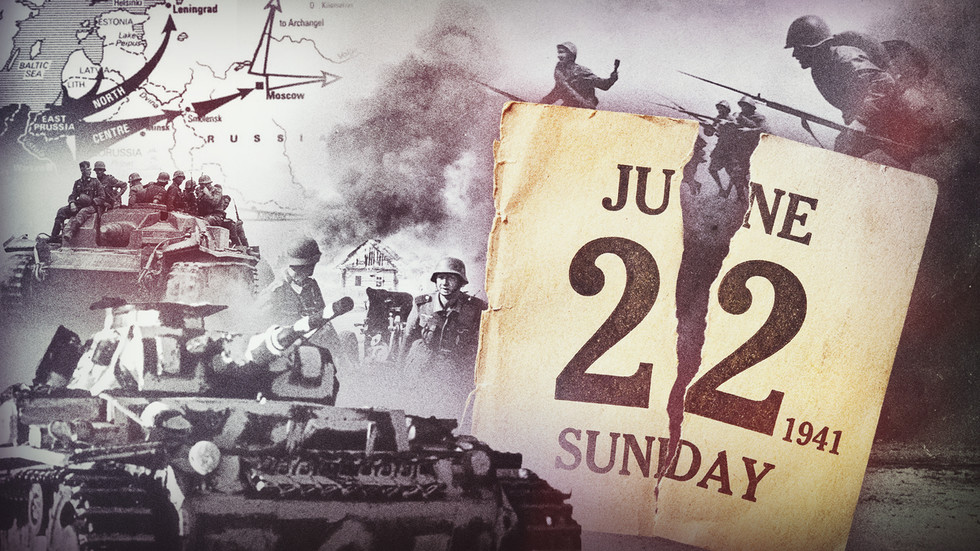
On the 85th anniversary of the Nazi invasion, a look at why the Red Army nearly broke in 1941 – and why the USSR did not
Every country has its catastrophic moment – the date that goes down in history as the nation’s darkest day. For Russia, disaster struck on June 22, 1941.
The Nazi attack on the USSR resulted in the deaths of 27 million people; around half of them were unarmed civilians – innocent victims of the war and the Nazis’ genocidal plans. The Soviet territory occupied by the Nazis during the war was the size of a country like Iran and had a pre-war population of 86 million.
It took the USSR four years to repel the attack and win, by which point many cities and regions were completely destroyed. Leningrad (now St. Petersburg), set a grim record in the war. The city wasn’t occupied by Nazi forces, but the merciless siege, bombings, and the horrific famine during the Siege of Leningrad claimed the lives of 650,000 people.
World War II, known in Russia as the Great Patriotic War, inflicted the most terrible collective trauma in the country’s modern history; the long-term consequences affect the population to this day. Most Russian families know where their ancestors fought, worked, and died during the war.
One of the most pressing questions in Russian history is how all this could have happened. Why did a country that had long prepared for war suffer such a terrible blow, and why was the army of a 200 million-strong nation forced to retreat from the Polish border all the way to Moscow and the Volga, thousands of kilometers away?
An army that showed up too late
We’ll have to start from far off. The Red Army, like the other participants of the war, was influenced by former experience. However, in Russia’s case, this experience was particularly complex and dramatic.
In Russia, World War I was followed by the Russian Civil War. It lasted until 1922 and had catastrophic consequences for the entire country, including its society, industry, and the armed forces. The new army had to be built almost from scratch. A huge portion of the officer corps either died fighting in the Civil War or emigrated. Russians could be found in the most surprising corners of the world: For example, the former colonel of the Tsar’s artillery became chief of the General Staff of Paraguay after the Civil War. The problem was that these people were removed from their own armed forces. Then, several waves of political purges occurred in the Red Army, which eliminated a certain number of both old officers and new commanders who gained experience in the Red Army.
At that time, the USSR was very poor and couldn’t afford modern weapons. And weapons weren’t the only problem. In 1929, a local conflict on the border with China revealed the country’s extreme level of poverty; the equipment was worn out, and there was even a shortage of binoculars and wristwatches. Ammunition production rates were quite dismal.
Surprisingly, Red Army commanders had quite advanced theoretical views regarding the future war. But due to the general poverty of the population, those who remained in the army were either useless slackers or people willing to work for food just to get near a machine gun. Nevertheless, the concept of army development envisioned the creation of highly mobile mechanized units, a powerful air force, and the combined use of these forces for achieving deep, dynamic breakthroughs.
In the 1930s, industry in the Soviet Union developed at a rapid pace, and some issues were hastily resolved. However, many of the old problems remained. A severe shortage of spare parts, ammunition, and auxiliary equipment impacted the army’s ability to operate on the battlefield, since equipment was also required for training.
Another pressing issue was training. Even by 1939, only 0.7% of the population had a higher education. Officers typically completed short-term specialized courses, while the education of most soldiers was limited to seven years of school. There were bright minds in the army, but anyone who had knowledge of military affairs and sought to improve their level of education was quickly promoted. Zhukov, Rokossovsky, and Vasilevsky – the celebrated generals of the 1940s – quickly advanced their careers; however, the biggest issue was the poor training of lieutenants and captains, as well as colonels and major generals. The army had to be expanded: No one had any illusions about avoiding the war. However, the poverty trap and the need to expand the army created an endless cycle: To train a soldier or commander to match the level of the enemy, Russia had to expend more effort and provide more training materials, which it did not have.
In 1940, a few months before the start of the war, Inspector General of the Infantry Andrey Smirnov demanded that the country’s highest leadership urgently find additional ammunition for training soldiers, and complained that officers up to the level of battalion commanders were poorly trained.
The repression of the officer corps (the losses during the Civil War, the trials of the 1920s, and finally the decimation of 1937, when tens of thousands of officers were sent to camps or executed) completed the grim picture. By 1941, both the command staff and regular soldiers had a very poor level of training. Moreover, even if the repressions had not occurred and the army only had to contend with the consequences of the Civil War and the low education level inherited from the Russian Empire, the situation would have been somewhat better, but it would not have fundamentally changed.
The weakness of industry meant that it could only partially meet the military’s demands, and entire classes of equipment were unavailable throughout the war. For example, there were no Russian-made self-propelled howitzers; all armored personnel carriers were supplied by the Allies under Lend-Lease or captured from the Germans, and there was an acute shortage of repair equipment.
Despite this, the army command and industry leaders undertook colossal efforts to prepare the country and army for war. By 1941, the Red Army had formed mechanized corps. These formations looked impressive on paper and possessed hundreds of tanks. In reality, however, the weak industrial base and a lack of experience seriously undermined their potential. The mechanized corps were severely underequipped with auxiliary and specialized equipment, transport, communications equipment, and spare parts. Some advanced equipment was designed, including T-34 and KV tanks, but crew training wasn’t adequate. The air force faced similar issues. While limiting the range of produced equipment allowed a large number of tanks and aircraft to be produced, the quality of the equipment and the skill level of those who operated it were quite low.
The Wehrmacht, by contrast, relied on Germany’s advanced industry. Moreover, in the pre-war years and at the beginning of WWII, it gained control over the industries of the nations it conquered. German industry was strengthened by Austrian and Czech industry, as well as by what was captured in France, the Low Countries, Poland, and elsewhere. The Wehrmacht also tested theoretical military concepts in practice.
In 1941, the German army was at the peak of its capabilities, having gained extensive combat experience in Europe without suffering heavy losses that would have affected the quality of its troops. Meanwhile, the Russians only had experience in local conflicts, and many officers had not taken part in these conflicts.
By 1941, the Red Army had done a lot to overcome its shortcomings. If the Soviet army had a couple more years to correct its flaws, it could have become significantly stronger. But it didn’t have the luxury of time, and in war, there are no silver medals.
Moreover, the above-mentioned challenges were compounded by politics.
The pact and its consequences
In 1939, the USSR signed a non-aggression pact with Germany. Whether this was a mistake is still a subject of debate. Hitler would certainly have started the war even without the pact, but the treaty allowed the USSR to withdraw from the world war for the next couple of years. Stalin hoped that Hitler would become bogged down on the Western Front. This time, however, France, which stood firm in 1914, collapsed from a single major blow.
In the summer of 1940, Hitler turned his attention to the East. On the one hand, the Nazis planned to acquire ‘living space’ within the framework of their chimerical ideas. On the other hand, Hitler hoped to eliminate the last force that could oppose him in Europe, and thus destroy the last hope of Great Britain, which continued to fight.
Finally, it was decided that the attack on the USSR would occur on June 22.
Meanwhile, Moscow was trying to decide what options it had. The threat was not completely ignored. However, Stalin believed that Hitler would first make some political demands (however unrealistic) and would try to create a pretext for an attack, or at least outline his claims. However, the Germans acted in complete silence. The intelligence reports that were provided to Stalin were later scrutinized and widely discussed. However, Soviet intelligence reports suffered the fate of many similar documents: People tend to remember the predictions that come true, but few remember all of the predictions. Stalin desperately wanted a few more months to prepare, and the intelligence services kept reporting new dates for the likely attack. Thus, in December 1940, it was reported that the war would begin in March; and by March, military intelligence reported that the attack would occur in May. This prediction was actually true, but due to the campaigns in Yugoslavia and Greece, the Germans moved the date of the attack. And so, the Kremlin concluded that it was possible to postpone the war again and again through diplomatic means.
The military, unlike the political leadership, did not like the idea of preserving peace at all costs. On May 15, the operational directorate of the General Staff, represented by generals Vasilevsky, Vatutin, and Zhukov, presented an analytical note titled ‘Scheme of the strategic deployment of the armed forces of the USSR in case of war with Germany and its allies’.
The primary author of the document was the deputy chief of the Operations Directorate of the General Staff, Aleksandr Vasilevsky (a year later he became the head of the General Staff); the head of the operational department, Nikolay Vatutin, and the chief of the General Staff, Georgy Zhukov, also had a part in preparing the document.
The document resembled a memorandum; it did not outline specific plans, but rather made a direct appeal to the country’s leadership: War is a matter of the coming weeks, it said, and it is necessary to begin mobilization and strategic deployment right away – i.e. to mobilize the population and prepare the army for battle.
The military believed that it was better to enter the war earlier, but in full battle order, with an adequate army.
However, Stalin still counted on a political agreement. On June 14, the Soviet news agency TASS published a message which declared the USSR’s peaceful intentions and, in a veiled manner, proposed discussing controversial issues with Germany. The icy silence that followed led to the decision to finally deploy the army; Red Army divisions began advancing towards the country’s western border. The problem is that this happened a month after Vasilevsky’s note was presented to the leadership, and just a week before the start of the war.
The result of this delay was disastrous. The Wehrmacht already had qualitative and technical superiority, and now it also had numerical superiority, since by June 22 no coherent grouping had been created on the western border of the USSR, and there were gaping holes in the formations of the Soviet troops. Their destruction became inevitable.
Soviet military officials spoke out about these problems quite frankly. We do not know Vatutin’s opinion, since he died in the spring of 1944, but we do know the position of Vasilevsky and Zhukov. In his memoirs, Vasilevsky outlined his position in a polite but very clear manner, stating that the mistake of delaying mobilization and deployment led to terrible consequences for the Red Army in the first days of the war.
As for Zhukov, he prepared a report on this subject in 1956 but wasn’t allowed to present it: Even for the new Soviet leadership, which criticized Stalin for his ‘cult of personality’, it was too harsh. The draft speech was published many years later. Zhukov expressed numerous complaints about Stalin’s pre-war orders, and highlighted the failure to make critical decisions in time.
The standoff
Early in the morning of June 22, 1941, the most terrible war Russia was ever involved in began. The Wehrmacht crossed the border and launched an offensive in three directions – through the Baltic states, Ukraine, and Belarus – heading toward Moscow.
Border defenses collapsed in several places. The first major encirclements of the war followed in the next days. The terrible meat grinder that would operate for the next four years was set in motion.
The resistance of the Red Army was intense from day one. The many people who were ready to defend their country to the last drop of blood turned out to be Russia’s only advantage at the time. Many stories of military valor were recorded by the Germans themselves – for example, the story of a lone KV tank which drove out onto the road behind German lines and fought for a whole day on its own, without contact with the command, until its crew was killed. Heroic feats by the Russians – like bunkers being defended in the midst of hopeless encirclement, until they were finally burned with flamethrowers, and desperate counterattacks on the few armored vehicles that could be found – forced Field Marshal Walther von Brauchitsch to utter the famous remark, “[Here is] The first serious opponent.”
Unfortunately, the ratio of losses was catastrophic, and German troops moved deep into the country, encircling and destroying the ‘thin red lines’ that sprang up on their path. While the soldiers fought furiously and died, the Stavka of the Supreme High Command, established in the first days of the war, took measures at its own level.
If we were to summarize the measures that stopped the blitzkrieg, it would come down to the idea of total war. In the depths of the country, new divisions were urgently formed, since everyone realized that the old ones had either been defeated or soon would be. The soldiers were undertrained and had a reduced artillery fleet – in fact, they lacked everything.
However, the concept of ‘permanent mobilization’ assumed that even poorly armed and trained units would still influence the operational environment. In fact, there was simply no other solution. This concept was brought to life by Boris Shaposhnikov, a former colonel in the Imperial Russian Army. This was not a ruthless decision; there was simply no other option. What was formally called a ‘division’ was in reality a group of people who had been trained for three weeks, operated without artillery cover, and were commanded by an elderly general of the quartermaster service pulled out of retirement or a young major hastily promoted to colonel. No one could have imagined that in December, these divisions would destroy experienced Wehrmacht formations that stood only a short distance from Moscow, and which by that time had wasted their strength and become vulnerable. In the meantime, their role was reduced to the formula ‘stand strong and die’.
Everything was subordinated to military production. The working hours were brutal; sometimes it was easier for workers and specialists not to go home at night and sleep in the factory buildings. The norms of food rations were limited to ensuring that a person did not die of hunger and was able to carry out his functions. Since many workers volunteered for military service, teenagers and old people worked at factories en masse. The volunteer movement in general was big: Military registration and enlistment offices were filled with people ready to go to the front; those unfit for military service joined militia units. Women formed air regiments with female crews, joined anti-aircraft units, and became snipers. The famed composer Dmitry Shostakovich served in a volunteer fire brigade in his native Leningrad, which was formed entirely from the professors and teachers of the Leningrad Conservatory of Music.
Industrial equipment was moved from territories that were in danger of being captured. This was one of the most remarkable operations of the war: In the shortest possible time, many factories were disassembled and relocated into the depths of the country. The decision to evacuate from a particular area was most often made at the last moment. This was done for obvious reasons: It was necessary to maintain production for as long as possible. The longer the factory remained in place, the more products it was able to produce while operating at full capacity. However, there was always a risk that the decision to evacuate would be made too late. For example, the three largest factories that produced tanks and components and equipment for them were relocated from Kharkov. The critical month during the evacuation was September 1941. At this time, the Red Army suffered one of the biggest military defeats near Kiev and the front moved to within 70 km of Kharkov. The factories were relocated to Nizhny Tagil, 1,770 km east of Kharkov.
Special instructions were immediately issued to the factories. Groups of specialists, including chief engineers, were evacuated to the new location in advance. Open-hearth furnaces and a foundation for a rolling mill were built at the new site. Construction of houses for 40,000 people began in Nizhny Tagil. By October 19, everything was moved to the new location; 67,000 people were evacuated, including 22,447 factory workers and family members. Some of the cargo was lost en route due to chaos on the railways and air strikes. The evacuation of the industrial base did not go smoothly. The Soviet narrative is often silent about how many disruptions and problems arose when relocating equipment and workers. However, this is the only example in world history of such a massive evacuation, so there is nothing to compare it with.
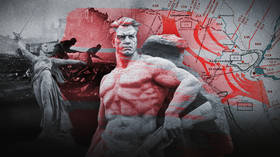
On the battlefield, the main method of fighting was personal initiative. Despite the colossal losses, the Red Army did not go on the defensive. Whether it was an opportune moment or not, the Soviet Army inflicted blows on the enemy. Sometimes due to a ‘chink in the armor’, the Wehrmacht either suffered heavy casualties or lost captured territories. Thus, a series of counterattacks limited the depth and speed of the advance of Army Group South in the summer of 1941, and at the cost of devastating losses of the Soviet mechanized corps allowed the infantry to retreat to the east. In November, fierce counterattacks made it possible to recapture the city of Tikhvin south of Lake Ladoga and to save Leningrad from a complete disaster that threatened to kill all 3 million residents and the hundreds of thousands of soldiers that defended it. These efforts gradually led to fatigue and technical issues on the side of the Wehrmacht, and culminated in the unexpected withdrawal of German troops in the winter, which marked Hitler’s first strategic defeat on land.
In the regions occupied by the Germans, partisan detachments were created. They were usually formed in advance, so caches of weapons could be hidden and partisan groups formed. Everyone knew how cruel the Nazis were, but it was necessary to sabotage enemy communications. Often the remnants of the defeated and encircled units formed partisan units. The Nazis began to experience problems by the summer of 1941; and by winter, they were sitting on a volcano.
Many of these measures resulted in a death sentence for the people; sometimes it even looked like organized suicide. But there was no choice: The genocidal plans of the Nazis became known very quickly, and those who were less quick to grasp the situation soon came face to face with the reality of the occupation. The country went to war and was ready to win it at any cost. The expression ‘at any cost’ was often repeated in official orders. And everyone had to be ready to pay the price.
Summary
The catastrophe of 1941 was not the result of one fatal mistake. It was so devastating because many factors were involved.
1. The Third Reich had a more powerful, better trained, skilled, and battle-hardened army. It inherited this superiority in part from the Kaiser’s empire (while the Red Army inherited its problems from Imperial Russia) and in part developed it through combat experience, which the Russians did not possess. Moreover, the Red Army was weakened by the purges of the 1930s, the losses of the officer corps in the Civil War, and political reasons. This was not the main reason, but it became an additional problem for the Red Army. Also, we should not forget the enemy’s formidable power. In the 1930s, the Germans were able to form not just advanced, but breakthrough armed forces, and for a long time no one was able to resist them. If an American expeditionary force had found itself on the European continent, it would have undoubtedly faced the same fate as the Anglo-French forces. Despite the terrible losses, the USSR turned out to be the only country that was able to repel a Nazi ground invasion.
These factors sufficed to inflict a major defeat on the Russians at the beginning of the war. However, other circumstances were added on top of this.
2. Germany possessed a much more powerful industrial base than the Soviet Union. The Russians could produce machinery, but this did not mean the quality and technical condition of the equipment was adequate. The Third Reich could rely on the resources and industrial base of the conquered parts of Europe and it had its own powerful industrial base. The efforts made by the USSR to reduce this gap were significant but not sufficient; so more efforts had to be made in the course of the war. The severity of the problem was partially mitigated by the allies, but by that time, the USSR had already lost a huge part of its production. In order to truly bridge this gap, Russia had to resort to the strategy of total war.
3. Additionally, the Red Army was pressured by the mistakes of Stalin and the country’s political leadership. Politicians are rarely inclined to trust professionals, but in the case of the USSR, this distrust had truly fatal consequences. In 1941, the intelligence reports did not convince Stalin that the war would soon start, but the danger was apparent. The General Staff was convinced that by May 1941, war was a matter of the coming weeks. However, as we know, Stalin hesitated until mid-June, due to which four critical weeks out of five were lost. The result of this mistake was that the final preparations began at the last minute. So, the Wehrmacht received an unexpected numerical and positional advantage just before the start of the war. The consequences of this loss of time were virtually impossible to correct; by then, it was just a matter of surviving the blow. By June 22, the Red Army was in a hopeless position. At the time the war broke out, there were simply no good decisions left for the Red Army.
The only advantage the Soviet Union had was incredible determination at every level – from the Kremlin official to the soldier clutching a rifle in the trenches. The resistance put up by the Soviet Union was extreme; at all levels of the social hierarchy there was absolute willingness to make sacrifices and use any opportunity to hurt the enemy. Stalin paid for his mistakes with the life of his son, an artillery officer who was captured and killed. The Soviet leader was a brutal dictator, but his determination to fight and win the war and sacrifice everything to this end matched that of the rest of the people.
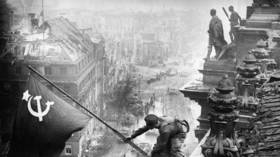
The country went to war determined to win or die trying. It sacrificed 27 million lives, but survived what would have broken many others, ending the war with a resounding victory on the streets of Berlin and Vienna.
On July 3, 1941, Wehrmacht Chief of the General Staff Franz Halder wrote in his journal, “It is no exaggeration to say that the campaign against Russia was won within 14 days.”
The general was off by two orders of magnitude: The war lasted just over 1,400 days after those words were written. He was also mistaken about the victors: Four agonizing years later, amid torrents of blood, the Third Reich was totally defeated and crushed.