
By MICHAEL SLOVANOS
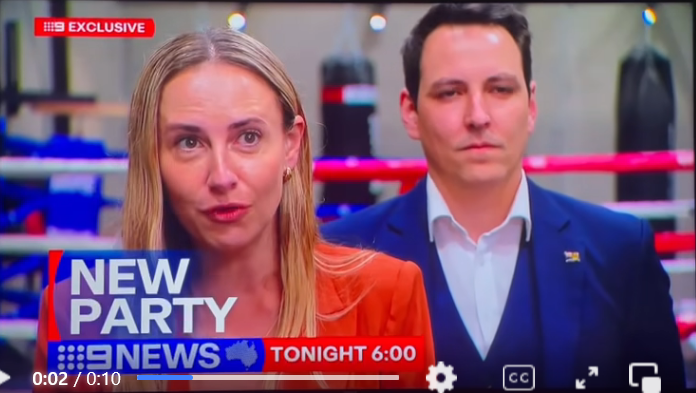
RIGHT on the eve of attempts to get Australia’s fragmented small parties working together, yet another mico-party has been launched, this time in South Australia – the Sarah Game Fair Go For Australians party.
“Our name is our platform: We’ll fight for a fair go for anyone who works hard, contributes and is loyal to Australia,” says the founder, former One Nation MP and South Australian Upper House MP Sarah Game MLC.
Ms Game apparently stands for commendable objectives such as fighting rampant feminism and gender activism, supporting war veterans and holding major parties to account, but her new party simply adds to the long list of non-mainstream parties already in existence.
In the words of Heart Party founder Michael O’Neill, who is hosting 10 minor parties for unity talks in Sydney this weekend, they have been “stepping on each others toes”.
“Success shouldn’t depend on being part of a minority group, your gender, ethnicity, sexuality or postcode,” says Ms Game. “We’re running candidates at next year’s state election, including Henry Davis, the brave, principled and truly authentic Adelaide City councillor.
“Rather than landing a Liberal a well-paid job in opposition, your vote really counts if Fair Go gets the balance of power. Fair Go is for anyone who’s had enough of the two major parties – and prefers common-sense, fairness and freedom!”
Cairns News cannot argue against that sentiment, and it’s common to all of the 10 parties meeting in Sydney.
But Ms Game will require lots of good luck because a minor conservative party holding the balance of power in any Australian parliament is not only unthinkable to the political establishment, but “unallowable” – at least where dirty political tricks have a chance of working.
So-called “convention” in Australia requires that governments must have a “workable majority” in order to pass legislation, although we are not aware of any such requirement in the Constitution.
Common arguments are that non-majority governments are “unstable”, as if that is a concern to the population at large, or that “agendas can get passed”. The only agenda that governments should be pushing is what Section 51 of the Constitution demands – peace, order and good government.
Controversial agenda items like The Voice should be decided by referenda or even better, by Citizens’ Initiated Referenda.
Tasmania is currently an example where one major party (the Liberals) has claimed “government”, but without an actual majority of MPs. They have been forced to set up a Crossbench Liaison Office “to enhance working protocols across Parliament”.
Are we supposed to be shocked and alarmed that a party sitting in the Parliament should be forced to liaise with other parties in passing legislation? In fact the Liberals should be commended for providing a system that “includes Ministers coordinating regular briefings for Members of Parliament, providing access to departmental information on upcoming legislation, and supporting independent analysis of major policies and bills.”
This is in stark contrast to “the government” sitting in Canberra where a gerrymandered electorate has given the Australian Labor Party a vast majority of 94 seats or 62% of the 151 seats based on just 36% of first preference votes of the Australian people – and they call it a “democracy”.
Australia, in effect, is ruled by a one party dictatorship. The only check on this power is the Senate where rigging of the preference vote flow has ensured that the Greens, effectively Labor’s far-left wing, has the balance of power.
In our current situation, where Labor’s own “left faction” owns the Prime Minister, Australia is under the sway of the most destructively leftist government since Gough Whitlam. The 64% of the electorate who did not vote for them, simply don’t count.
Meanwhile, in the past two decades, small parties have only once made a dent in this system, notably in Queensland in 1998 when “the unthinkable” did happen and the populist One Nation won more than 22% of votes (439,121) and 11 seats in the Legislative Assembly.
That year, One Nation gained a higher percentage of the vote than any other third party (i.e. not Labor or the Coalition) at the state or territory level since Federation, which illustrates the grip of the two-party system.
In February 1999, party inflighting led to five of the 11 One Nation MPs leaving the party and sitting as Independents. Then the political establishment kicked in and in August that year the Queensland Supreme Court found the party’s registration to be “fraudulent”, leading to the party’s deregistration by the Electoral Commission.
A One Nation-style populist revolution is possible again but not with the current proliferation of small parties pushing their own little barrows. Within them are good people with Australia’s welfare their main concern – not a globalist new order.
This will require the co-operation of established minor parties like One Nation and Katter’s Australia Party who have representatives sitting in state and federal seats.
If the 10 parties meeting in Sydney can at least agree to a unified ticket at the next state or federal elections, that alone might create a credible voting block with preference vote impact to swing a One Nation or KAP candidate into a seat.