A federal court has ruled that the Air Force inappropriately diverted thousands of service members from the Integrated Disability Evaluation System (IDES), which is a congressionally mandated process for evaluating disabilities.
The court determined that an unauthorized prescreening process, known as Initial Review-in-Lieu-of (IRILO), violated the Administrative Procedure Act. IRILO effectively prevented wounded, injured, or sick service members from receiving the medical evaluations and protections they are entitled to.
The decision, made by the U.S. District Court for the Eastern District of Virginia, highlighted that the Air Force lacked the authority to create such a process.
The lawsuit, filed in July 2025 by former Air Force personnel, including Kathleen L. Watts and Robert Newman, argued that this prescreening mechanism denied them consideration for medical retirement benefits due to their medical conditions incurred in the line of duty.
Although the case illustrates a significant issue where service members were stripped of their rights and protections under federal law, the prescreening process remains in place for now, as the court has yet to finalize a remedy for the matter. Meanwhile, as this could potentially impact tens of thousands of service members, the possibility of a larger class action hangs in the balance.
The Gateway Pundit interviewed retired Air Force pilot and advocate for injured service members, Jeremy Sorenson, who stated, “The US Air Force has long known that the IRILO is a completely illegal process. But, because it ‘saves’ the Air Force money, senior leaders have refused to correct it.” In August 2023, Sorenson informed Lt. Gen. Stephen Davis (SAF/IG) that the Air Force was using the IRILO to improperly deny Airmen entrance into the congressionally-mandated Disability Evaluation System processing (IDES).
Again, in October 2024, after numerous communications about the unlawful treatment of injured service members to Lt Gen Davis had fallen on deaf ears, Sorenson made very specific allegations, including that the US Air Force was engaged in:
“Unlawful denial of IDES entry through (a) arbitrary and capricious Return to Duty (RTD) Recommendations in the Review In Lieu Of (RILO/IRILO) process, and (b) forced entry into NDDES (Non Duty Disability Evaluation System).”
“The Air Force took no corrective action, despite me copying nearly 200 senior leaders and Inspectors General,” Sorenson disclosed. “In fact, Lt Gen Davis conducted a yearlong IG inquiry on injured service member/line of duty issues that we brought forward, but he conveniently omitted and avoided every specific cited violation of law that we identified to him…nothing to see here, people are just confused.”
When asked what he thinks about the Court’s ruling, Sorenson said, “It’s fantastic, but it should never have required a court to step in. I hope this is finally a wake up call for Secretary Meink and Secretary Hegseth. You can’t allow your staff bureaucrats to just ignore problems and hope they’ll go away…especially when those problems are hurting your people and their families.”
On Thursday, The Gateway Pundit contacted Lieutenant General David Lyons, the Inspector General of the Department of the Air Force (SAF/IG), via email to ask the following questions:
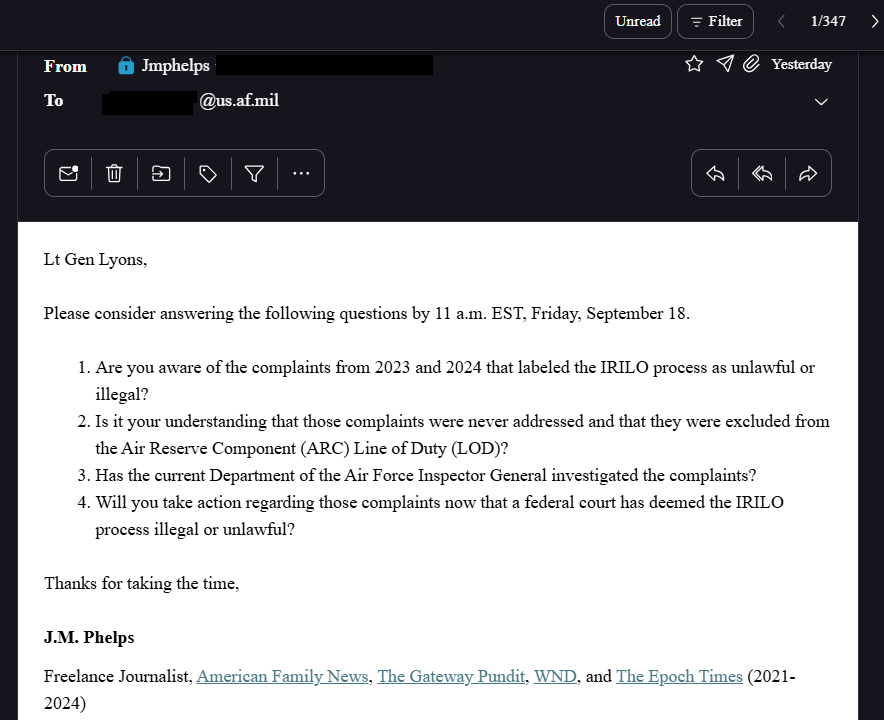
The author respectfully awaits responses from Lt. Gen. Lyons and Lt. Gen. Davis, who did not respond by press time.
Additionally, in light of these developments and concerns, The Gateway Pundit spoke with Walk the Talk Foundation President Ryan Sweazey, whose organization has assisted hundreds of service members navigate Inspector General complaints.
He provided the following insights: “There is a pattern emerging in the Air Force Inspector General system which I find unsettling, quite frankly, and it very much reeks of an ongoing quid pro quo arrangement: its Inspector General ensures the institution is protected and the institution, in turn, rewards its Inspector General.” He argued, “The IRILO affair is a demonstrative exemplar of this collusion: the Air Force’s ‘independent watchdog’ consistently turned a blind eye to a patently illegal practice, and its head was subsequently promoted. What other conclusion should one draw from that?”
The author also conducted an interview with retired Air Force Lieutenant Colonel and military defense attorney Davis Younts to shed more light on the court’s decision. The former Judge Advocate General (JAG) officer said there has been significant overlap between the language and terminology of the Department of Defense, that is, the Department of War, and that of the Department of Veterans Affairs (VA). The two are, in fact, separate federal government agencies when it comes to how they manage injured service members.
“We ought to view the VA not merely as VA disability but rather as VA compensation,” Younts explained, clarifying, “some individuals receive VA compensation despite not being disabled, meaning that VA compensation is for any injury you incurred, regardless of your disability status.”
This distinction is crucial, especially when navigating the complexities of service-related injuries.
In this context, VA compensation is for injuries suffered, whereas the IDES process primarily focuses on assessing whether a service member is suitable to remain on active duty. If it is determined that they are not fit for active duty, there are subsequent procedures that lead to medical retirement.
This is the heart of the issue, Younts argued: “The IDES system has been broken for a long time.” He said, “Units throughout the Air Force have long been frustrated with the lengthy [IDES] process, as it can leave them with someone unable to perform their job stuck in a system that may take six, 12, or even 18 months to complete.” In his opinion, the Air Force tried to get efficient and creative by establishing a screening process to decide if a service member should enter the IDES system.
“The problem with that is that there was no statutory authority to do it,” Younts pointed out. If a service member is found to have a medical profile that could render them unfit, there are specific statutory and regulatory procedures that must be adhered to.
“Without appropriate administrative procedure in place and due process for the individuals involves,” he said, “this prescreening process leads to mistakes.” This concern is particularly significant given the legal framework surrounding these issues.
At the Court of Federal Claims, there is a statute of limitations of six years. This could impact thousands of service members who may find themselves beyond this six-year threshold. The solution for cases that are older than six years lies with the Board of Corrections for Military Records (BCMR), yet it has often been largely ineffective on various other issues.
In conclusion, while the prescreening procedure currently stands, the push for accountability and proper administrative practices is essential for safeguarding the rights of those who have served their country. The ongoing dialogue among legal experts, military personnel, and advocates will be pivotal in driving necessary changes for a more equitable system that honors the sacrifices of service members and protects their rights moving forward.
Ad block users: Some site features may not work correctly while an ad blocker is enabled, because they break scripts and content this website depends on. If you can’t see comments below, for example, please disable your ad blocker.