
WHEN one of South Australia’s two sea water desalination plants began operating at full capacity in January this year, it also began discharging a large amount of saline water and chemicals into the Spencer Gulf.
Stage one of the plant at Lonsdale, just south of Adelaide, commenced operations in October 2011, and stage two commenced in July 2012. The plant was officially opened on 26 March 2013. Up until January it had only been operating at around 10% of capacity.
The Adelaide Desalination Project is the largest infrastructure project that the State of South Australia has funded and owns, and in 2017, it produced 2% of the state’s water supply.
Due to low rainfall in 2024, in January 2025 the plant’s production increased to its full capacity of 300 megalitres (ML) of water per day.
The state has a total of 14 desalination plants, but only two of them treat sea water. The second sea water one is at Penneshaw on Kangaroo Island.
The toxic bloom was first detected in March off the Fleurieu Peninsula and it has plagued South Australia’s coastline for most of the year, creating discoloured water and foam and countless dead creatures that have washed up on shore.
The bloom also reached metropolitan Adelaide beaches, where locals captured images of dead sharks and sea lions.
The Londsdale plant boasts that it provides “a climate-independent source of drinking water delivering up to 100 billion litres of water each year, contributing half of Adelaide’s water supply”.
“The supplementary Kauwi Interpretive Centre creates a memorable experience for visitors, with key messages around the importance of desalination, quality water supplies, sustainability and Indigenous heritage.”
What they don’t want to brag about is the suspected effects of this desalination plant’s discharges into the nearby waters of the Spencer Gulf. It’s apparently not very sustainable at all.
Desalination plants have a nasty byproduct – highly saline water which is left over after desalinated water for urban supplies is filtered off.
Turning Point SA spokesman George Mamalis says it appears that the State Government is trying to cover up the desalination plant outfall as a possible cause of the state’s disastrous algal bloom that has killed fish around the coastline of the Spencer Gulf.
Mamalis is not just spouting his own opinion, but has found warnings against desal plant outfalls and the Adelaide one in particular, from an international consultancy group called Global Marine Resource Management Pty Ltd.
An article posted online by the group states that the recent activation of the Adelaide desal plant and the coincidental toxic algae bloom causing the widespread marine fauna deaths is cause for concern.
“As shown by the chlorophyl map … the bloom including the toxic marine algae occurred close to the Adelaide plant which discharges brine and maintenance chemicals into a relatively sheltered near-shore environment,” the article states.
The map, shown by Mamalis online, shows red areas near the shore which indicates high levels of chlorophyl i.e. algae growth.
The article continues: “Notably, to reduce harmful impacts, dispersion jets are used to rapidly dilute brine and potentially toxic chemicals at the point of discharge, and in doing so, the strong jets can mobilise sediments and release nutrients and previously dormant cysts of toxic algae species, including algae, causing the current devastating bloom.
“The disturbance to near-shore sediments and conditions favourable for rapid increase in the growth of toxic algaes such as elevated temperature, nutrients and sunlight present plausible causes of bloom.
“Public statements which seek to diminish or exclude the role of desalination plant discharge as a cause, are inconsistent with desalination plants anywhere else in the world, which have been associated with harmful algae blooms.
“This underscores the considerable risk presented by a proposed desalination plant off Port Lincoln, which is adjacent to a designated agricultural zone.”
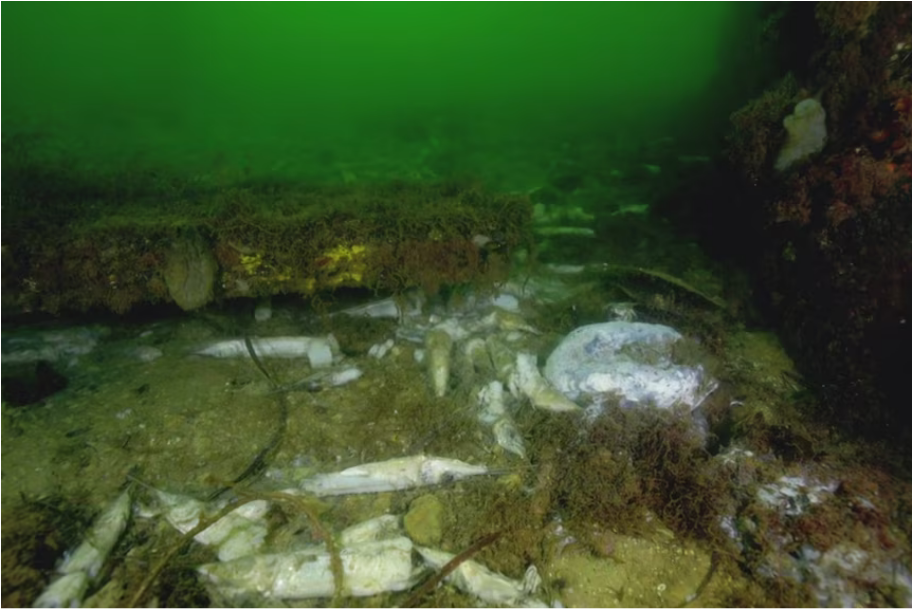
The ABC reported that a marine scientist and filmmaker Stefan Andrews, who captured the footage near the Ardrossan jetty on SA’s Yorke Peninsula, said he saw “hundreds, if not thousands” of fish — mostly garfish — strewn across the seabed.
But neither the ABC nor the marine scientist pointed to desalination plant discharges as a potential cause.
The ABC quoted a spokesman for SA’s Department of Primary Industries and Regions (PIRSA) who said testing of waters around Ardrossan confirmed the presence of Karenia mikimotoi, the species responsible for the toxic algal bloom that has been choking the state’s coastlines since March.
The South Australian Labor government, meanwhile, is pretending it doesn’t know the cause of the algae bloom and is says “it can do nothing” except hand out monetary relief to fishermen whose source of income has been decimated.
The SA Environment Minister Susan Close said back in June that despite ongoing storms and cooler temperatures, “we are seeing the algae being very persistent”. She said the bloom was “not something that is likely to pass quickly”, was “likely also to return at some point” and “we are helpless in the force of nature”.
Really Dr Close? So a major industrial plant that pumps highly saline water into the Spencer Gulf in jets that stir up sediment has nothing to do with a toxic algae bloom?