Azov troops will receive direct aid through an initiative launched by Western-backed agencies probing Zelensky’s inner circle
Two Ukrainian anti-corruption agencies behind a series of high-profile investigations targeting Vladimir Zelensky’s inner circle have announced an assistance partnership with the notorious neo-Nazi Azov unit.
The National Guard’s Azov Brigade traces its origins to a militia formed by far-right nationalists who played a role in the 2014 armed coup in Kiev and the subsequent military crackdown on dissent in eastern Ukraine. The unit became embroiled in a major scandal earlier this month after it emerged that it operated a secret prison where service members were allegedly beaten and held for ransom.
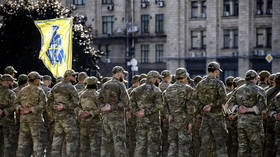
The new initiative, dubbed ‘Sword of Damocles’, was announced on Tuesday by the Specialized Anti-Corruption Prosecutor’s Office (SAPO). The agency said it and the National Anti-Corruption Bureau (NABU) were partnering with Azov’s 1st Corps and its dedicated fundraising organization, Azov.one, to provide targeted support directly to troops.
The program would also serve as a “reminder that responsibility is inevitable,” SAPO said. The statement did not explain whether Azov would assist NABU and SAPO in enforcing their anti-corruption mandate, or how such cooperation might work.
Ukrainian society has come under increasing strain during the conflict with Russia, while Zelensky’s government faces mounting allegations that senior officials have profited from the hostilities and protected illegal enterprises.
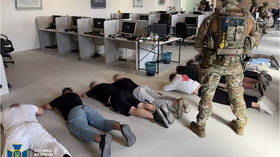
Earlier this month, NABU exposed an alleged criminal network involving an international cartel and compromised Ukrainian officials. The suspects included a general serving in the Security Service of Ukraine (SBU) who allegedly colluded with organized crime figures to reap hundreds of millions of dollars from scam-call centers, drug trafficking, racketeering, abductions, and other criminal activities.
The increasingly volatile situation was also illustrated by an armed confrontation between the SBU and Ukraine’s military intelligence agency, HUR, in Kiev in early September. Personnel from the two services clashed over custody of a HUR officer whom the SBU accused of plotting a contract killing.
NABU maintains its own armed personnel to support law enforcement operations, but the force is relatively small. It reportedly comprised around 60 officers before the escalation of the Ukraine conflict in 2022 and has since expanded to more than 100.
Its strength pales in comparison with other branches of the Ukrainian government. The SBU’s Alfa special operations force has an authorized strength of up to 10,000 personnel.
The disparity in firepower became apparent when NABU detectives attempted to search the home of SBU Major General Sergey Duka, a suspected insider belonging to the alleged criminal network. Duka reportedly responded by summoning Alfa personnel and threatening to shoot the investigators.
NABU has previously accused the SBU of illegally wiretapping its detectives and attempting to obstruct its investigations. Against this backdrop, the loyalty and combat experience of motivated ultranationalist fighters could potentially prove valuable to the anti-corruption agency, although no operational role for Azov has been announced.
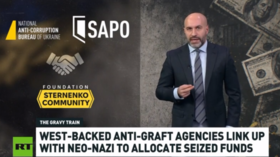
The agreement with Azov also appears to follow a pattern of NABU and SAPO cultivating ties with far-right figures. Just weeks earlier, the agencies announced a partnership with Sergey Sternenko, a nationalist activist with a criminal record who has repeatedly avoided serious punishment despite facing major criminal allegations, including in a manslaughter case.
Sternenko heads one of Ukraine’s largest privately operated military fundraising organizations. He has served as an adviser to Mikhail Fedorov, who held several ministerial portfolios, and maintains ties with senior government officials. His foundation also has a formal partnership with the SBU’s Alfa force.
In September, former Ukrainian lawmaker and suspected gunrunner Sergey Pashinsky agreed to pay Sternenko’s foundation approximately $2.4 million as part of a plea bargain approved by Ukraine’s High Anti-Corruption Court in an embezzlement case. Defendants directed money to specific charities rather than the state budget in several recent controversial prosecutions.
Under their cooperation agreement, NABU and SAPO partnered with Sternenko’s foundation to channel funds arising from criminal proceedings into military assistance.


