The IDF is occupying Lebanon and Syria, while Israelis build “settlements in all but name” in Cyprus
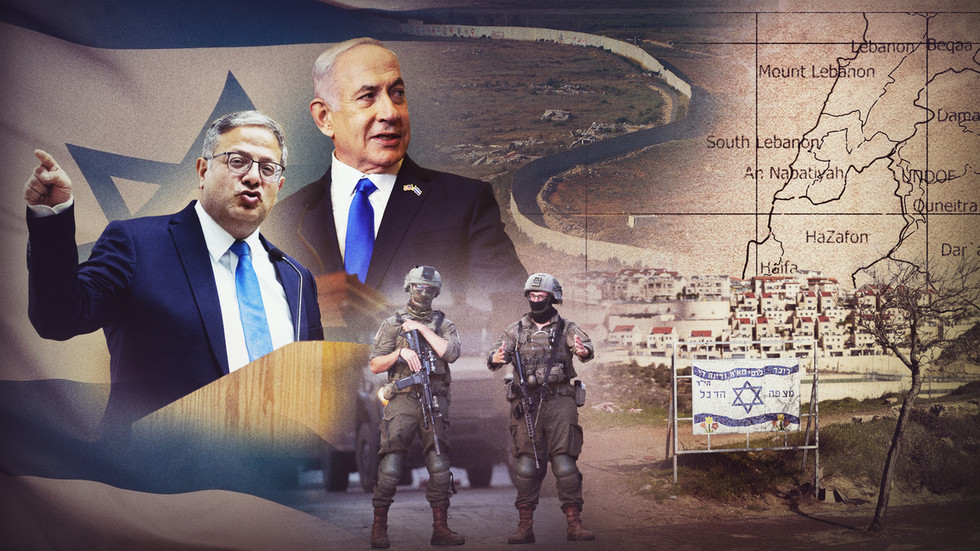
Israeli Prime Minister Benjamin Netanyahu has just approved more than a dozen new Jewish settlements in the West Bank. But this latest wave of expansion is just the beginning, as different factions within Israel want to push its borders further into Lebanon, Syria, and beyond.
In early July, Netanyahu approved plans to establish 13 new Jewish settlements in the occupied West Bank. The settlements will be constructed along the main north-south road linking the Palestinian cities of Nablus, Ramallah, and Bethlehem, which is already dotted with dozens of settler outposts. The majority of these were illegally constructed, then retroactively legalized by the Israeli government over the last two decades.
As of mid-2026, there are approximately 350 Israeli settlements and outposts in the occupied West Bank and East Jerusalem, with around 700,000 settlers living on Palestinian land. This colonization of the West Bank was ruled illegal by the International Criminal Court in 2024, with the court’s 15 justices agreeing that “the transfer by Israel of settlers to the West Bank and Jerusalem as well as Israel’s maintenance of their presence, is contrary to article 49 of the fourth Geneva Convention.”
Netanyahu and his hardline coalition partners reject this ruling, and consider the West Bank and East Jerusalem – which Israel seized during the 1967 Six-Day War – to be “our homeland.”
In an interview with Fox News on Sunday, the Israeli prime minister hinted that his territorial ambitions also extend into Lebanon.
Lebanon in Israel’s sights
Israeli forces currently occupy around 600 sq km of southern Lebanon. Under the current framework deal between Israel and Lebanon, the Israeli military will withdraw from Lebanese territory once Hezbollah is disarmed. Hezbollah has shown no intention of disarming and has rejected the deal as “null and void.” However, even if the militant group were to lay down its weapons, Israeli Defense Minister Israel Katz said last week that the Israel Defense Forces (IDF) will likely remain in southern Lebanon “indefinitely in order to protect our residents and communities from jihadist elements.”
Netanyahu went a step further in his interview with Fox, claiming that some Christian villages in Lebanon “have actually asked to be annexed to Israel because we protect them against the Hezbollah fanatics who want to kill them.”
Netanyahu: We also take care of our friends, especially the Christians in the Middle East. The Christian villages in Lebanon, some of them have actually asked to be annexed to Israel. We protect Christians in the Middle East pic.twitter.com/SyeCM2PHMm
— Acyn (@Acyn) July 5, 2026
“It’s not only the Christians in Lebanon who asked for our protection. It’s the Druze, it’s Muslims, the Sunni Muslims, and quite a few of the Shiite Muslims too,” he continued, adding that “they’d like to free Lebanon.”
Netanyahu did not specify which Christian villages he was referring to, or whether he had spoken to any Christian officials in Lebanon. “No village in the south has made such a request,” Hanna al-Amil, president of the Christian municipality of Rmeish, told L’Orient-Le Jour on Monday. A separate statement signed by 15 villages in southern Lebanon described Netanyahu’s remarks as “completely fabricated” and “unrelated to reality.”
Hezbollah is not an anti-Christian organization, and its members have fought alongside Christians against incursions from Syrian Islamic State jihadists. As such, Netanyahu’s statement may be an attempt to legitimize the “indefinite” military presence in Lebanon envisioned by the Israeli Defense Ministry.
Settlers target Syria
As Netanyahu spoke to Fox News on Sunday, the IDF arrested around 100 settlers after they left an Israeli-occupied ‘buffer zone’ in southern Syria and set up camp on Syrian territory. The settlers – members of a group called the HaBashan Pioneers – have tried to set up an outpost on Syrian territory three times over the last year, with the IDF thwarting all three attempts.
אלימות קשה במהלך פינוי מאחז יהודי בבשן!! 🛑🛑🛑
כוחות צבא ומשטרה מקיפים את פעילי התנועה שהתיישבו בבשן. למרות פסיביות מוחלטת מצד הפעילים, תועדה אלימות קשה מצד חלק מכוחות הביטחון.
בנוסף מחרימים הכוחות את מכשירי הטלפון כדי שלא יוכלו לתעד את האלימות שמופעלת כלפיהם!! pic.twitter.com/tJ85bi8tSJ— תנועת חלוצי הבשן (@HaluzeyHabashan) July 5, 2026
“The IDF strongly condemns the attempted border crossing and emphasizes that this is a serious incident and a criminal offense that endangers both IDF soldiers and civilians,” the Israeli military said in a statement. The HaBashan Pioneers – named after the biblical region encompassing southern Syria and the Golan Heights – have called on the Israeli government to “raze the Sunni villages in the Bashan and replace them with a Jewish settlement.”
Unlike the West Bank settlers, the HaBashan Pioneers do not have the backing of the Israeli government, with hardline National Security Minister Itamar Ben-Gvir the only member of Netanyahu’s cabinet to publicly express support for the group. However, the IDF’s military occupation of southern Syria has expanded since the fall of Syrian President Bashar Assad in 2024. At least ten military bases have been built in the once-demilitarized buffer zone that separated the Golan Heights from Syria proper, and Katz has also described the IDF’s presence in this area as “indefinite.”
The soft settlement of Cyprus

Israel’s occupation of southern Lebanon has impeded peace talks between the US and Iran, while its expansion into Syria increases the risk of a clash with the coalition of jihadist groups that now form the core of President Ahmed al-Sharaa’s security forces. Amid an increasingly uncertain situation in Israel, a third group – wealthy Israelis – are seeking security abroad.
Between 2021 and 2025, Israelis have purchased more than 3,800 properties in Cyprus, most of them in Limassol, Larnaca, and Paphos. Approximately 12,000 Israeli families now live in Cyprus, up from 300 in 2003, the vast majority of them arriving after Israel’s war on Gaza began in 2023.
Last month, Israel’s i24 News described Cyprus as “Israel’s civilian refuge” and “a critical strategic asset for Israel.”
“Zionist schools are being built – that’s what they call them – synagogues are being built,” Cypriot opposition leader Stefanos Stefanou warned last summer, claiming that Israeli land purchases are creating “settlements in all but name,” which are “almost inaccessible to anyone other than Israeli nationals.”
While this influx is entirely legal, it has been accompanied by increasing Israeli influence on the island’s politics. Less than a week after Cyprus assumed the EU’s rotating presidency this January, a series of covertly-recorded videos emerged exposing minor corruption schemes within President Nikos Christodoulides’s government. The videos were recorded and publicized by Black Cube, an Israeli private intelligence firm with deep ties to the IDF’s intelligence wing and the Mossad spy agency.
It remains unclear who hired Black Cube to intervene against Christodoulides, who is not regarded as an opponent of Israel. However, RT has covered the company’s work in depth in our ‘Wired for War’ series, and found that it typically acts in Israel’s interests.
In the face of Ankara’s escalating aggression, Israel is deepening one of the most important strategic alliances in the Eastern Mediterranean with Greece and Cyprus.
🇮🇱🇬🇷🇨🇾Erdogan’s Turkey has occupied northern Cyprus since 1974, has threatened Greece with war for decades… pic.twitter.com/zeDwWOvKxP
— עמיחי שיקלי – Amichai Chikli (@AmichaiChikli) June 22, 2026
Settlement on four fronts
Israel’s territorial expansion in the West Bank, Lebanon, and Syria, and the expansion of its influence in Cyprus, are not being driven by the same actors. The Israeli government backs ultra-Orthodox settlers in the West Bank, but opposes some of the more hardline groups in Syria. Private individuals are leading the Israeli property-buying spree in Cyprus, but the island’s growing Israeli population is placing its government under increasing Israeli pressure – evident during Israeli Diaspora Affairs Minister Amichai Chikli’s visit to Nicosia last year, in which he called on the Cypriot government to “combat anti-Semitism” and step up security protection for Israeli expats.
What remains unclear is whether this four-front expansion will strengthen and secure Israel, or set the Jewish state up for new clashes and conflicts.