The German team’s World Cup defeat to Paraguay is a metaphor for the country’s loss of prestige
Germany’s dismal World Cup performance offered no reprieve for a country already reeling from multiple economic and social crises, and Chancellor Friedrich Merz is struggling to sell the loss to Paraguay as a show of “strength.”
Germany lost a penalty shootout to Paraguay at Boston Stadium on Monday night, turning the country’s World Cup dreams into what German tabloid Bild called a “football nightmare.”
The defeat in the first knockout stage of the tournament came as a surprise: Germany has won four World Cups, three European Championships, and never lost on penalties in football’s most prestigious tournament. The Germans entered the competition at 10th in FIFA’s world rankings, with Paraguay sitting in 41st.
However, these triumphs are becoming a thing of the past for Germany. After winning the World Cup in 2014, Germany failed to make it out of the tournament’s group stages in 2018 and 2022, and on Monday, manager Julian Nagelsmann conceded that “this is the third elimination in a row, so we are not part of the first-class teams any more.”
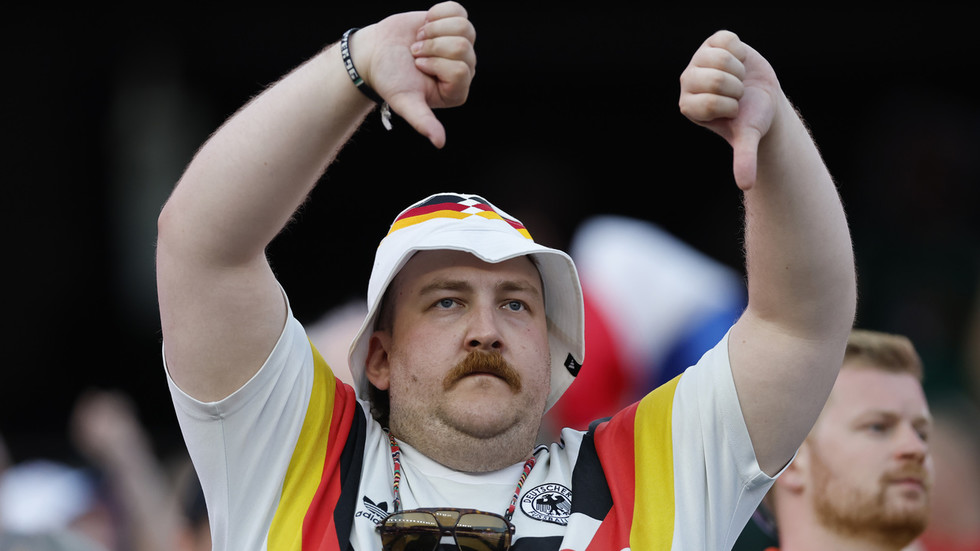
Bild referred to Monday night as “the night of shame,” but Merz attempted to put a positive spin on the loss. “With your commitment and team spirit at this World Cup, you have thrilled our country,” he addressed the team in a post on X, as fans back home in Germany smashed their beer bottles and left watch parties in dismay.
日本隊是世界一流水準的球隊,
日本球迷也絕對是世界一流水準的球迷!看看德國輸球後球迷們的表現…
摔瓶子、打人,一地狼藉!
最後這些垃圾他們會帶走吧?
😅😅😅 pic.twitter.com/3mj2xOzPbw
— のらいぬ (@JapanBanZaiLove) June 30, 2026
“We celebrate our successes together. And in defeat, we stand united,” he wrote in a follow-up post. “That is what makes us strong. Whoever wears the eagle on their chest has earned our support and not our scorn.”
Erfolge feiern wir gemeinsam. Und in der Niederlage stehen wir zusammen. Das macht uns stark. Wer den Adler auf der Brust trägt, hat unseren Rückhalt verdient und nicht unseren Spott.
— Bundeskanzler Friedrich Merz (@bundeskanzler) June 30, 2026
Merz misses the mark
Merz’s message – described by the Express tabloid as “insane” – didn’t console the tens of thousands of Germans who flooded his replies. “This tweet stands for everything that’s wrong in this country. And then people wonder why you’re the most unpopular politician on the planet,” author and entrepreneur Mario Lochner replied.
“Even in football, the current ‘New Germany’ is nothing more than third-rate,” satirist Johannes Normann quipped.
“Chancellor, that was a rock-bottom kick,” right-wing author Oliver Gorus wrote. “They were miserably led and have rightly been eliminated. A mirror image of the whole country.”
To the country’s most popular political party, the right-wing Alternative for Germany (AfD), the national team’s performance was a metaphor for the performance of Germany under Merz. “It seems that Merz is applying the same yardstick to the national team as he does to his governing coalition,” AfD co-chairman Tino Chrupalla posted. “This performance was not exactly thrilling. The principle of performance must apply once again – for the chancellor and federal ministers, the national coach and the national players. Germany must get back to the top!”
Germany’s decade of humiliation
Germany’s post-2014 World Cup drought mirrors the country’s decline into global irrelevance over the last decade. Barely a year after striker Mario Goetze scored the winning goal over Argentina in the 2014 final in Brazil, Chancellor Angela Merkel threw open the country’s borders to more than a million Middle Eastern migrants. The ensuing gang rapes, stabbings, and vehicle attacks shattered the country’s social cohesion, making Germany a byword for the failures of multiculturalism.
Once Europe’s economic and industrial powerhouse, Germany then dealt itself a one-two blow by phasing out nuclear power in favor of unreliable renewables, before cutting itself off from cheap Russian gas when the Russia-Ukraine conflict escalated in 2022. Energy costs soared, the German economy experienced two years of contraction, followed by two years of sub-1% growth, and more than a dozen German manufacturers have closed plants and fired workers in the last four years.
Among these manufacturers are BASF, Bosch, and Volkswagen, which announced its first German plant closure in its 90-year history in December. Volkswagen, Germany’s largest automaker, whose success is usually seen as a barometer of the country’s overall economic health, followed this closure by announcing four more factory shutdowns and the loss of nearly 100,000 jobs in June.
Merz and his predecessor, Olaf Scholz, stood by and said nothing as the multibillion-dollar Nord Stream gas pipelines were bombed by Germany’s allies – either the US or Ukraine. Scholz’ rearmament program, which Merz continued with the promise of building “the strongest conventional army in Europe,” has achieved little, except driving the country’s budget deficit far above the 3% limit set in place by the EU and keeping the manufacturing sector limping along with arms contracts, at a cost to the taxpayer of €111 billion ($130 billion).
Germany’s decline was certified on the world stage earlier this month when the country failed to secure a seat on the UN Security Council for the first time since 1977. Germany’s loss at the UN was widely blamed on its hypocritical foreign policy positions: obsequious support for Israel’s actions in Gaza on one hand, and condemnations of Russia’s actions in Ukraine on the other.
One embarrassment to the next
Lifting a World Cup wouldn’t have alleviated any of these problems, but for a nation as pathologically averse to patriotism as Germany, it would have at least given the public something to celebrate.
Cameroon beat defending champions Argentina in the opening match of the 1990 World Cup in Italy, and made history as the first African nation to reach the quarter-finals of the tournament. South Korea’s defeat – on home turf – of Italy and Spain in 2002 set off an outpouring of patriotic celebration on the streets of Seoul. Ireland’s unexpected charge to the quarter-finals of Italy 1990 was a welcome reprieve after the economic malaise of the 1980s, and the months of revelry that followed are still remembered as a societal turning point, before the economic boom kicked off in earnest in the 1990s.
Sporting success can lift a nation’s spirits, and a win for Germany could have lifted Merz’ miserable approval ratings, which currently sit somewhere between 16% and 19%. Instead, Germany continues to go from – in the words of AfD leader Alice Weidel – “one embarrassment to the next.”