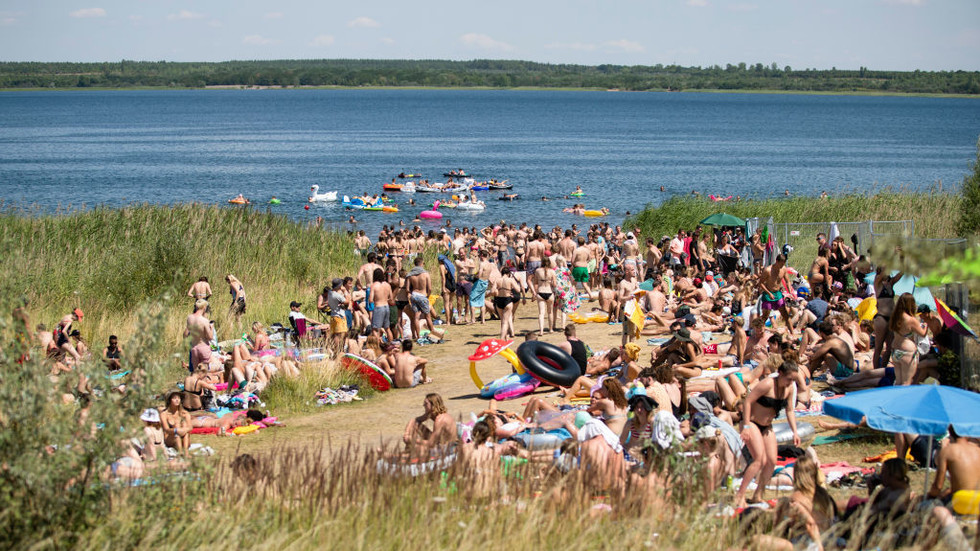
A lake resort operator has claimed that lifeguards’ instructions were not understood, causing unacceptable risks
A controversial move by the operator of a lakeside beach in Germany to refuse entry to swimmers who do not sufficiently speak German has sparked a fierce political row.
The dispute erupted after the privately run Heidebad nature pool in Halle in the eastern state of Saxony-Anhalt announced earlier this month that staff may turn away visitors who are unable to understand safety instructions in German.
Pool manager Mathias Nobel, who also works as a lifeguard, said the policy was introduced after repeated dangerous situations in which warning signs, depth markers and lifeguards’ instructions were not understood or ignored.
“The Heidebad swimming pool is convinced that an angry visitor is better than a preventable swimming accident,” reads the statement on the pool’s website. It goes on to explain that “in isolated cases, guests were refused entry if, in the operator’s opinion, sufficient communication regarding safety-related information was not possible.”
Alexander Vogt, the mayor of the city of Halle, claimed the restriction excludes “entire population groups” and said Nobel could be perceived as “acting in a xenophobic manner,” as quoted by Die Welt on Wednesday. The mayor also argued the policy could violate the lease agreement and has demanded its reversal.
City officials have proposed multilingual safety information, pictograms and QR codes instead of language-based admission checks, while both sides are seeking a compromise.
Nobel rejected accusations of discrimination, insisting the policy is motivated solely by safety.
“I bear responsibility for thousands of beachgoers. When it comes to the safety of children and families, I will not compromise,” he said in a statement on the pool’s website.
The dispute has also become part of Germany’s wider political debate over immigration.
The right-wing Alternative for Germany (AfD) party backed Nobel, saying on Facebook on Tuesday that his “decisive action reveals the dramatic failure of uncontrolled immigration in everyday German life” and blaming the “misguided policies of the established parties.”
Immigration has become one of the defining issues in German politics after years of historically high inflows. At the end of 2025, Germany had 14.1 million foreign nationals, about 17% of its population, according to official data, with the largest groups coming from Turkey, Ukraine, Syria, Romania and Poland.
In Saxony-Anhalt, the AfD currently leads opinion polls with around 40–42% support ahead of the September 6 state election.
You can share this story on social media: