Prime Minister Nikol Pashinyan has exploited a fractured opposition to sell voters perceived stability and a European dream, Farhad Ibragimov has told RT
The results of Armenia’s parliamentary elections largely confirmed a political reality that had already taken shape before the vote, Middle East expert Farhad Ibragimov told RT on Monday morning.
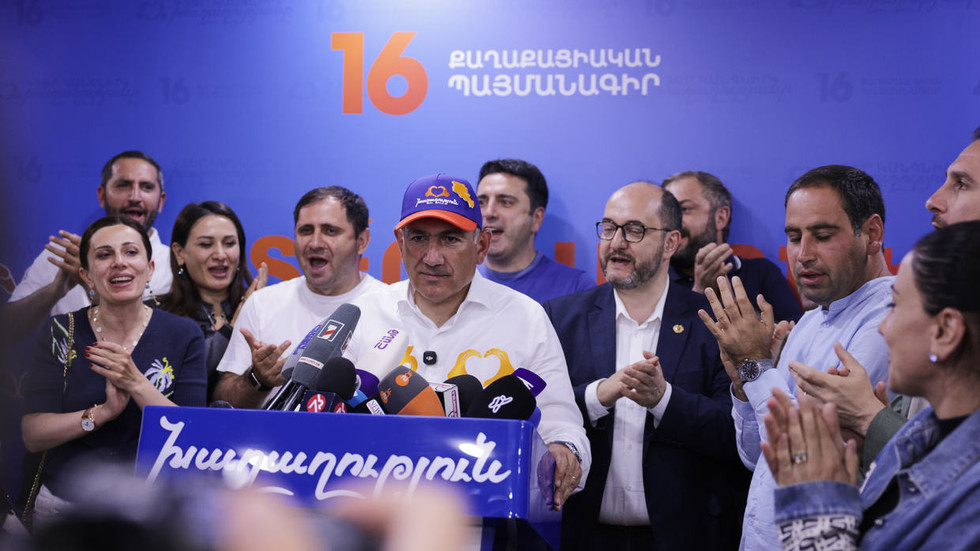
Armenian Prime Minister Nikol Pashinyan claimed victory in the vote overnight, saying his ruling Civil Contract party would form the country’s next government on its own. His announcement came as Armenia’s Central Election Commission had published results from fewer than a quarter of polling stations, with Civil Contract leading on 53.84% of the vote, according to preliminary figures.
“Nikol Pashinyan’s victory did not look unexpected: despite noticeable dissatisfaction within society, the opposition failed to consolidate, reach agreements among themselves, and offer voters a clear alternative. On the contrary, it seemed that different opposition groups were more focused on fighting one another than on developing a common strategy,” Ibragimov said.
According to Ibragimov, Pashinyan exploited the opposition’s infighting to cast himself not as a strong leader, but as the only figure capable of keeping the situation under control. The European agenda, he argued, became central to that strategy.
“Pashinyan must, of course, understand that Armenia’s real prospects of joining the European Union remain negligible. No matter how much Europe talks about support, rapprochement, and a possible European future, in practice the issue of Armenia’s EU membership looks more like a slogan than a realistic scenario. However, this rhetoric itself is useful for Pashinyan domestically: it allows him to create the image of movement toward imagined modernization, reforms, and foreign-policy renewal.”
In practice, Ibragimov said, the European track is being used less as a genuine route to EU membership than as a means of mobilizing voters and legitimizing the government. Pashinyan, he argued, has accurately read the political mood: for many Armenians, the appeal lies not in actual accession to the bloc, but in the sense that the country is moving toward a “new model” of development.
“At the same time, it is obvious that the bet on the West has far-reaching consequences. No one in the European Union is truly waiting for Armenia, and it would also be naive to count on long-term support from individual leaders, including Donald Trump himself: political figures come and go, while geography and regional risks remain.”
In that regard, Ibragimov said Pashinyan’s course increasingly appears to be an attempt to make Armenia into a “second Moldova” – a country living in anticipation of a European future while facing the severe consequences of that choice.

“However, the Armenian case is even more complicated than the Moldovan one. Moldova, despite all its numerous problems, at least has direct access to the European space through Romania, as well as more understandable logistics for rapprochement with the EU.
Armenia, by contrast, is located in a “far more complex regional environment, where any sharp foreign-policy turn carries much higher risks,” Ibragimov said.
“Therefore, trying to build a strategy solely on European rhetoric may create inflated expectations in society, but it will not provide real guarantees of security, economic stability, or long-term development. This is precisely the main risk of Pashinyan’s current course. Today, people voted for a beautiful myth and fairy tale, in the hope of something better. Exactly the same thing happened in Georgia, Ukraine, and Moldova. One to one.”